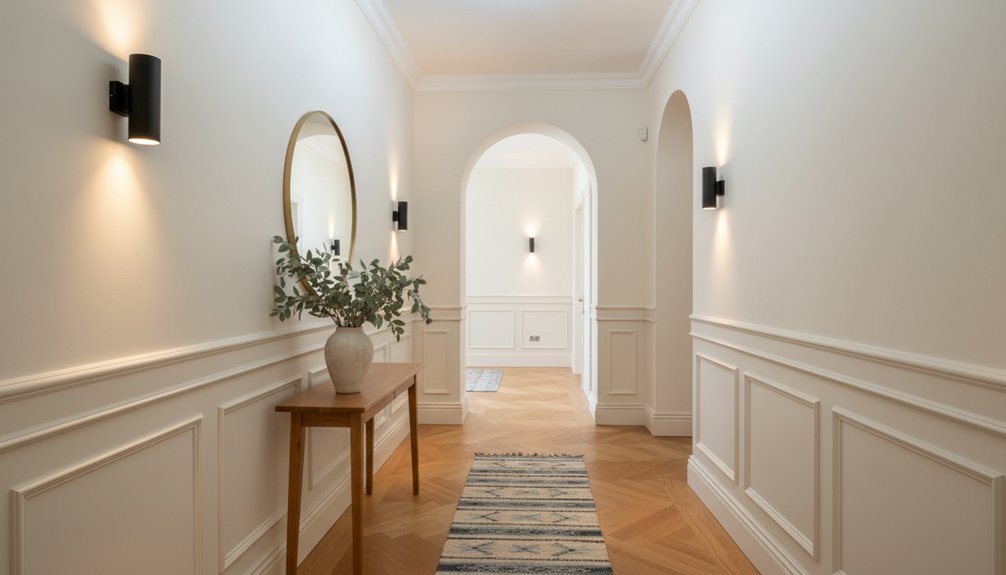
Start by mapping your hallway’s traffic flow, pinch points, and daylight so every choice supports easy movement. Brighten it with satin or eggshell walls, lighter ceilings, and crisp high-gloss trim, then layer lighting with a strong ceiling fixture plus slim frosted sconces at 60–66 inches. Add a low-pile runner that leaves 3–5 inches of floor showing, and tuck in a 10–12-inch console with closed storage. Keep going for gallery, mirrors, and styling tips.
Key Takeaways
- Plan the hallway’s flow by measuring pinch points, door swings, and sightlines before choosing decor or furniture.
- Brighten the space with layered lighting: a strong ceiling fixture plus slim wall sconces and a small accent lamp for warmth.
- Use light-reflective finishes—eggshell walls, lighter ceiling paint, and high-gloss trim—to make the corridor feel taller and cleaner.
- Add depth without clutter using paneling or small-scale wallpaper, and hang a mirror opposite light sources to bounce daylight.
- Choose a low-pile runner with 3–5 inches of floor showing and add shallow storage (10–12 inches) to keep pathways clear.
Start With Your Hallway’s Shape, Traffic, and Light

Before you pick paint colors or décor, map out what your hallway actually has to handle—its width, length, and where people naturally cut through. Measure pinch points at door swings, note sightlines from adjoining rooms, and mark drop zones for shoes, bags, or a slim console.
Then study daylight: track when it hits, where it fades, and which surfaces reflect it best. Use that data to choose flooring options that match traffic and proportion—wide planks to visually widen, durable tile for entry grit, or low-pile runners for long corridors.
Finally, audit overhead volume. Simple ceiling designs can stretch space: paint the ceiling slightly lighter, add subtle beams for rhythm, or run a narrow crown to sharpen edges without crowding.
Layer Hallway Lighting: Ceiling, Sconces, Lamps

You’ll get a polished hallway fast when you balance a clean-lined ceiling fixture with the right lumen output to keep the path bright and shadow-free.
Then you can add slim wall sconces to build depth, highlight artwork, and visually widen tight stretches without eating up floor space.
Finish the layer with a small accent lamp on a console or shelf to warm the mood and bring a boutique-hotel glow.
Balance Overhead Ceiling Lights
How do you keep a hallway from feeling flat under a single overhead fixture? You balance overhead lighting by choosing the right scale, beam, and placement.
In tight corridors, swap bulky domes for slim, semi-flush ceiling fixtures that hug the plane yet still read intentional.
In longer runs, use two or three smaller fixtures instead of one bright center point to smooth shadows and avoid a “spotlight” effect.
Pick warm LEDs (2700–3000K) for a welcoming tone, and add a dimmer so mornings feel crisp while evenings feel soft.
Matte black, aged brass, and opal glass stay on-trend without stealing width. Keep finishes consistent to make the space feel longer, not busier.
Add Wall Sconces Depth
Even with a well-scaled ceiling fixture, wall sconces add the mid-level glow that keeps a hallway from reading like a tunnel. Place them about 60–66 inches from the floor so light hits faces, not foreheads, and space pairs 6–8 feet apart to smooth shadows.
Choose diffused shades or frosted glass for soft ambient lighting, and aim beams up and down to elongate tight walls.
Match the finish to your hardware for a cohesive line, but use form to add interest: slim cylinders for modern corridors, curved arms for vintage warmth.
If you’ve got plaster, grasscloth, or paneled wainscoting, let grazing light highlight wall texture without glare.
Put them on a dimmer so evenings feel calmer.
Style With Accent Lamps
Wall sconces set that flattering mid-level glow, but a small accent lamp adds the warm pool of light that makes a hallway feel lived-in, not lit.
Tuck one on a slim console, wall shelf, or built-in ledge so it doesn’t steal inches from your walk path. For tight spaces, choose Accent lamp styles with narrow bases: mini ceramic gourd, ribbed glass mushroom, or a cordless metal dome.
Aim for a shade that hides the bulb and throws light down and out, softening hard corners.
Dial in lighting fixture placement by staggering heights—ceiling light for wayfinding, sconces for facial glow, lamp for ambience.
Put the lamp near art or a mirror to double the impact, and set it on a timer for nightly consistency.
Choose a Durable Hallway Runner (Size + Material)

Because a hallway takes constant foot traffic, a durable runner needs the right proportions and fibers from the start: choose a width that leaves 3–5 inches of floor showing on each side for a tailored, designer look, and size the length to stop a few inches shy of door swings and thresholds so it never bunches.
Treat it like durable flooring: add a quality pad to prevent slipping, quiet steps, and extend wear.
When comparing rug materials, lean into low-pile wool for resilience and easy vacuuming, or solution-dyed nylon for stain resistance in busy homes.
Flatweave cotton feels casual but shows dirt faster, so reserve it for low-traffic zones.
For a trend-forward finish, pick subtle texture, micro-patterns, or a bordered runner that visually elongates tight corridors.
Choose darker grounds to hide scuffs.
Hallway Wall Treatments: Paint, Paneling, Wallpaper
You can change a hallway’s entire vibe by choosing paint colors and finishes that bounce light, hide scuffs, and sharpen the trim.
Add paneling—picture-frame molding, beadboard, or slim vertical slats—placed as a lower wainscot or full-height feature to bring structure without stealing width.
Then top it off with wallpaper that uses scale, pattern, and texture (grasscloth, linen-look, or subtle metallic) to add depth while keeping the corridor feeling clean and intentional.
Paint Finishes And Color
Even if your hallway only gets a sliver of daylight, the right paint finish and color palette can sharpen the architecture and make the space feel intentionally styled. Choose a satin or eggshell sheen for walls; it bounces light without spotlighting every ripple. Save high-gloss for trim to add crisp contrast and a modern edge.
Use color psychology to steer the mood: warm off-whites and soft greiges feel welcoming, while inky blues or deep olives read boutique-hotel and hide scuffs. If you want height, paint the ceiling a half-step lighter than the walls. For width, keep adjacent rooms in the same undertone so sightlines flow.
Prioritize paint durability with scrubbable formulas, especially near doorways and switch plates.
Paneling Styles And Placement
While paint sets the overall tone, paneling adds instant structure—visually correcting proportions and protecting high-traffic walls in one move.
In a narrow corridor, run wainscoting to about 36–42 inches to widen sightlines and stop scuffs from bags and shoes.
If your ceilings feel low, take board-and-batten higher (two-thirds height) to pull the eye upward without darkening the passage.
For a modern, tailored look, choose slim-profile wood paneling with clean reveals; for heritage charm, pair it with crisp decorative molding and a substantial cap rail.
Align stiles with door casings and light switches so everything reads intentional.
Keep panels shallow in tight halls to preserve clear walking space and avoid snag points.
Wallpaper Patterns And Texture
Once paneling sets the lines and proportions, wallpaper brings the personality—adding pattern, depth, and light play that paint alone can’t match.
In a narrow hall, choose small-scale geometrics or pinstripes to visually widen the run; in a taller foyer, vertical motifs pull the eye up. You’ll get the most impact by papering one feature wall and keeping adjacent walls quiet, so the space doesn’t feel busy.
Lean into textured finishes like grasscloth, linen-look vinyl, or plaster-effect papers to soften acoustics and disguise scuffs. If you want drama, commit to bold patterns in deeper tones, then balance them with crisp trim and warm, even lighting.
Finish with a matte ceiling to keep glare down.
Plan a Hallway Gallery Wall (Layout + Spacing)
Because a hallway is narrow and fast-paced, your gallery wall needs a layout that reads cleanly at a glance and spacing that feels intentional—not crowded. Start by choosing a simple grid for modern homes or a tidy salon-style for eclectic ones, then map it with painter’s tape.
Keep 2–3 inches between frames, and align centers at about 57 inches from the floor for an art-gallery feel.
Tie the arrangement to your color schemes: repeat two core tones and one accent across mats, frames, and artwork to avoid visual noise.
Let furniture placement guide boundaries—end the composition before a door casing, and keep it centered over a bench or runner’s visual axis.
Anchor with one larger piece, then step down in size for rhythm.
Add Slim Hallway Storage for a Clean Drop Zone
If your entry hallway tends to collect keys, mail, and bags, add slim storage that turns that clutter into a polished drop zone without stealing walking space. Start with a shallow console (10–12 inches deep) or a wall-mounted ledge so the pathway stays clear.
Install a row of hooks above it, then add a narrow shelf to corral sunglasses and wallet essentials. Use divided trays for mail and a small catchall for loose change, and you’ll create clutter free zones that feel intentional.
Choose Slim storage solutions with closed fronts—flip-door shoe cabinets or slim drawers—so daily mess disappears fast. Finish with labeled bins inside for hats, dog gear, or chargers, and keep the top surface strictly limited to two items.
Final Hallway Touches: Mirrors, Greenery, Decor
With your slim storage keeping the drop zone streamlined, you can shift the focus to the details that make the hallway feel finished—mirrors, greenery, and a few well-chosen decor pieces.
Hang a tall mirror opposite a light source to bounce brightness deeper into the corridor and visually widen tight walls. Layer mirrored accents through a tray, picture frame, or narrow console styling to add polish without bulk.
Bring in indoor plants that suit your light: a trailing pothos on a high shelf, a snake plant by the door, or a slim vase of eucalyptus for scent. Keep decor edited—one sculptural bowl for keys, one textured runner to soften steps, and a small art pair hung in a clean grid.
You’ll get impact, not clutter.
Frequently Asked Questions
What’s a Realistic Budget Range for a Hallway Makeover?
You can realistically budget $300–$1,500 for a simple refresh, $1,500–$5,000 for a mid-range makeover, and $5,000–$12,000+ for built-ins or structural changes.
Start with budget planning: prioritize lighting, paint, and runner rugs to maximize a narrow footprint.
Watch material costs—tile, millwork, and custom storage jump quickly.
Include 10–15% contingency for surprises like drywall repair or electrical updates.
Do I Need Permits to Add New Hallway Electrical Outlets?
You might need permits to add new hallway outlets—if you’re running new wiring, adding a circuit, or modifying a panel, most jurisdictions require one.
If you’re simply swapping an existing receptacle, you usually don’t. Check your local building department, because rules vary.
Prioritize electrical safety: use GFCI/AFCI where required and proper box fill.
Plan outlet placement to stay code-compliant, avoid clutter, and support sleek lighting.
How Can I Soundproof a Hallway to Reduce Echo and Noise?
You can soundproof a hallway by layering absorption and sealing leaks. Mount slim Acoustic panels high on walls or the ceiling to cut echo without stealing width.
Add a runner plus a dense pad, and hang heavy drapes on any adjacent openings.
Use Soundproofing materials like door sweeps, weatherstripping, and caulk around trim.
Swap hollow doors for solid cores, and consider acoustical art for style too.
Which Hallway Upgrades Add the Most Resale Value?
You’ll add the most resale value with upgrades that read high-end and low-maintenance: refresh Lighting fixtures with layered, warm LEDs and statement sconces.
Update Flooring options to continuous hardwood or durable luxury vinyl for a seamless flow.
Repaint in modern neutrals with crisp trim.
Swap to solid-core doors and upgraded hardware.
Add built-in, slim storage or a bench where space allows.
And hang a large mirror to amplify light and depth.
How Do I Choose Art That Matches My Home’s Overall Style?
Start by pulling 3–5 style cues from your home—palette, finishes, and vibe—then choose art that repeats them through Color coordination, framing, and subject matter.
If you worry it’ll feel too “matchy,” mix one contrasting piece to keep it current.
Keep scale space-smart: large art for big walls, smaller sets for narrow zones.
For Gallery walls, use consistent mat widths and frame tones, and test layouts with paper templates.
Conclusion
When you treat your hallway like the spine of your home, every detail supports a smoother day. You’ve sized lighting in layers, chosen a tough runner, and upgraded walls with paint, paneling, or wallpaper that feels current. Your gallery wall lands with intentional spacing, while slim storage keeps keys and bags off the floor. Finish with a mirror to bounce light, a touch of greenery, and edited decor—small moves, big impact.
About the Author