You’ll get a fresh contemporary palette by matching paint to your home’s fixed finishes and true lighting, since undertones shift under LEDs and from morning to night. Build cohesion with 3–5 core hues: a main neutral, a trim/ceiling white, a deeper accent, and one or two supporting tones. Keep undertones consistent across sightlines, and use matte walls with satin or semi-gloss trim for modern contrast. Check LRV in darker rooms, then keep going for room-by-room guidance.
Key Takeaways
- Start by assessing natural and LED lighting, then test large samples morning, afternoon, and night to confirm true undertones.
- Build a cohesive whole-house palette with 3–5 core hues: main wall neutral, trim/ceiling white, accent shade, and supporting tones.
- Match undertones to fixed finishes like floors, countertops, tile, and metals so new paint looks intentional beside oak, marble, or brass.
- Create modern contrast with consistent trim sheen and bolder door or accent colors like charcoal, olive, or navy to guide sightlines.
- Avoid common mistakes by checking LRV and choosing appropriate sheens, then use proper prep and wet-edge painting for seamless results.
Choose Contemporary Paint Colors for Your Light and Finishes

Before you commit to a “perfect” contemporary paint color, map it to the light you actually live in and the finishes you can’t ignore—floors, countertops, tile, and metal. Pull samples and view them morning, afternoon, and night; LEDs can skew whites green or pink, while north light cools everything down.
Use color psychology to match function: warm greiges feel welcoming in living areas, crisp soft whites read clean in kitchens, and muted blue-grays calm bedrooms without going icy. Check undertones against fixed materials—oak wants softer neutrals, marble prefers quieter, cleaner companions, and brass can handle warmer walls.
Plan paint application techniques early: choose the right sheen, prep patches, and keep a wet edge for seamless, modern walls.
Build a Whole-House Palette (How Many Colors You Need)

Once you’ve nailed a few contemporary paint contenders, build a whole-house palette by deciding how many colors you actually need to make the home feel cohesive without looking matchy. For most renovations, you’ll land on 3–5 core hues: one main wall color, one trim/ceiling white, one deeper accent, and one to two supporting tones for bedrooms or cabinetry.
Use color psychology to assign roles: calm neutrals for daily spaces, a moodier shade for focus or intimacy, and a brighter note for energy. Then plan paint application techniques so the scheme reads intentional—matte on walls to soften glare, satin on trim for clean lines, and durable semi-gloss where hands hit.
Document sheen, codes, and placements so every contractor stays aligned.
Make Colors Flow Room to Room With Undertones
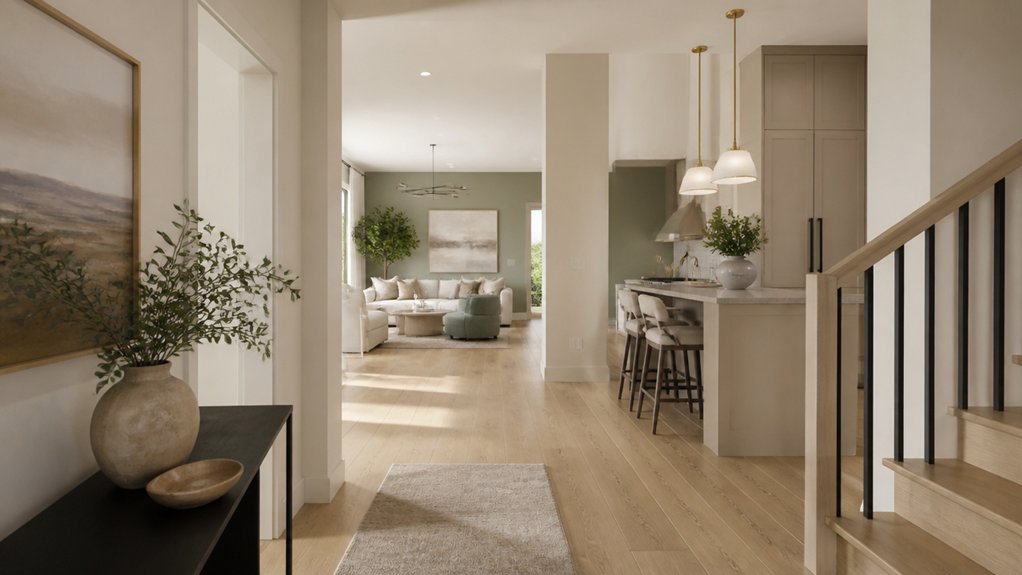
Although you can mix plenty of paint colors in a renovation, undertones are what make them feel like they belong together as you move from room to room. Start by identifying a consistent base: warm (yellow/red) or cool (blue/green).
Then test each candidate in the same light conditions, because LEDs, north light, and adjacent finishes can flip a “neutral” from creamy to gray.
Use Color psychology to set intent: warm greige reads welcoming in living zones, while cooler blue-grays feel focused in offices. Borrow cues from historical color trends—muted clay, dusty olive, and chalky whites—to keep your choices current without feeling trendy.
Finally, carry one shared undertone throughout hallways and sightlines so progression feels seamless, not choppy.
Add Modern Contrast With Trim, Doors, and Accents
When your wall colors share a clean undertone, you can sharpen the whole renovation with modern contrast in trim, doors, and accents. Specify crisp white or soft black on baseboards and casings to frame openings like gallery mats. Then echo that contrast in stair rails, built-ins, or a fireplace surround.
If you’ve got Decorative trim, treat it like architecture: highlight profiles with a single, confident finish instead of letting it blend away.
Use Accent doors to steer sightlines—paint a pantry, powder room, or office door a deep charcoal, olive, or inky navy, and keep adjacent hardware consistent. Swap dated switch plates for low-profile styles, and repeat metal tones in lighting and cabinet pulls.
You’ll get a tailored, contemporary edge without overpowering your palette.
Avoid Common Contemporary Paint Mistakes (LRV, Sheen, Samples)
Before you commit to that “perfect” contemporary shade, check three easy-to-miss factors that can derail the finish: LRV, sheen, and sampling.
LRV (Light Reflectance Value) controls how bright or moody a color reads; in open-plan homes, a low LRV can feel luxe, but it may swallow light in north-facing rooms. Use Color psychology to balance calm neutrals with energizing accents, not just what’s trending.
Next, match sheen to traffic and texture: matte hides drywall flaws, eggshell cleans easier, and satin can spotlight patchwork if your prep isn’t tight.
Finally, sample smart—paint large swatches on multiple walls, observe morning-to-night shifts, and follow paint application techniques: consistent roller nap, wet edges, and proper dry time.
Frequently Asked Questions
How Do I Estimate the Total Paint Cost for a Full-House Renovation?
Estimate total paint cost by measuring paintable wall and ceiling square footage. Then divide by coverage (typically 350–400 sq ft/gal) and add two coats plus 10% waste.
Multiply gallons by your chosen paint price, then add primer, caulk, tape, and supplies.
Factor labor by room complexity and ceilings. Your color palette may require extra coats.
Choose a paint finish per space—eggshell for walls, semi-gloss for trim—to price accurately.
Should I Repaint Ceilings the Same Color as Walls for a Modern Look?
Yes—you can repaint ceilings the same color as walls for a modern look, especially in rooms with clean lines and minimal trim. You’ll get strong color consistency and a cocooned, gallery-like feel.
If you want ceiling contrast, keep the ceiling 10–20% lighter or use a soft white to lift height and bounce light. You’ll also hide cut lines better with matte ceiling paint.
Always sample first.
How Long Should I Wait Before Moving Furniture Back After Painting?
Wait at least 24 hours before you move furniture back; give it 48–72 hours if humidity’s high or you used a deep color.
Picture the room like a fresh latte: smooth on top, but still warm underneath.
For smart furniture placement, keep pieces 6–12 inches off walls at first and use felt pads.
Respect paint drying time, then open windows, run fans, and avoid rugs for two days.
What’s the Best Way to Prep Older Plaster Walls for Contemporary Paint?
Start by checking for loose plaster and hairline cracks; you’ll scrape, reattach with plaster washers, and patch with a setting compound.
If you’re doing Wallpaper removal, score, steam, and rinse off all adhesive so you don’t get fisheyes.
Then focus on Surface smoothing: skim coat, sand with a pole sander, and vacuum dust.
Seal with a quality bonding primer, spot-prime patches, then apply two durable, low-sheen coats.
How Do I Choose Eco-Friendly, Low-Voc Paints Without Sacrificing Durability?
You choose durable low-VOC paint by checking third-party certifications (GREENGUARD Gold, Green Seal) and demanding scrub-rating data, not marketing claims.
You’ll get better performance if you pair it with eco-friendly primers matched to your substrate, then apply two proper coats.
For color, ask for natural pigment options that hold up to UV and cleaning.
Stick with waterborne acrylic or hybrid enamels for trim and high-traffic rooms.
Conclusion
You’ve curated a contemporary palette that feels less like a makeover and more like a quiet reinvention—your own design-era “Odyssey.” By balancing light, finishes, and a tight whole-house color plan, you’ll get seamless flow, not choppy shifts. Let undertones do the heavy lifting, then sharpen the look with crisp trim, modern doors, and punchy accents. Keep an eye on LRV, sheen, and real samples, and you’ll land a polished, on-trend result.
About the Author