
You can build an eco‑friendly new home with recycled and reclaimed materials if you set measurable targets for embodied carbon, recycled content, toxicity, and service life, then translate them into specs for strength, moisture, contaminants, and traceability. You’ll budget for testing, cleaning, and certification, and vet suppliers using EPDs, chain‑of‑custody, QA/QC history, and lot logistics. Design for energy, moisture, fire, and variable material properties, then install with controlled prep and documentation. Continue for the step-by-step system.
Key Takeaways
- Set embodied-carbon, recycled-content, toxicity, and durability targets, then convert them into measurable material specifications and allowances.
- Build a sourcing plan using a bill-of-materials map, prioritizing high-impact items and pre-approved substitutes to avoid delays.
- Vet salvage and recycling suppliers with EPDs, chain-of-custody, batch IDs, and third-party testing for contamination and strength.
- Design assemblies for performance—moisture, fire, and structural robustness—assuming reclaimed materials vary and require access for inspection.
- Standardize handling and installation, then maintain a materials log with receipts, photos, test reports, and QC sign-offs for compliance.
Set Goals, Budget, and Specs for Recycled Materials

Before you source a single reclaimed beam or recycled-content panel, define measurable goals, a realistic budget, and material specs tied to lifecycle performance. Set targets for embodied carbon (kgCO2e/m²), recycled content (% by mass), toxicity (HPD/Declare), and durability (service life, corrosion class, wear rating).
Translate goals into specs: allowable contaminants, minimum strength grade, moisture limits, and traceability documentation. Build a budget that separates premiums for testing, cleaning, and certification from base material cost, and include contingency for supply variability.
Align Material sourcing with critical path scheduling so substitutions don’t trigger rework. Require supplier evaluation criteria: EPD availability, chain-of-custody records, QA/QC procedures, and corrective-action history.
You’ll control performance risk while protecting long-term O&M outcomes.
Find and Vet Reclaimed/Recycled Materials (Quality + Logistics)

With your embodied-carbon targets, recycled-content thresholds, and performance specs set, you can now source reclaimed and recycled materials without letting variability derail schedule or durability.
Start Material sourcing with a bill-of-materials map that flags high-impact categories and acceptable substitutes, then build a short list of salvage yards, demolition contractors, and certified recyclers.
Require traceability: chain-of-custody records, origin photos, batch IDs, and third-party test reports where available.
For Supplier evaluation, score vendors on lead times, lot sizes, contamination controls, storage practices, and take-back options.
Inspect representative samples early, document defects, and confirm processing steps (de-nailing, cleaning, grading).
Lock logistics by reserving stock, setting pickup windows, and planning staged deliveries to minimize handling damage and rework.
Include warranties where feasible.
Design Around Energy, Moisture, Fire, and Structural Performance
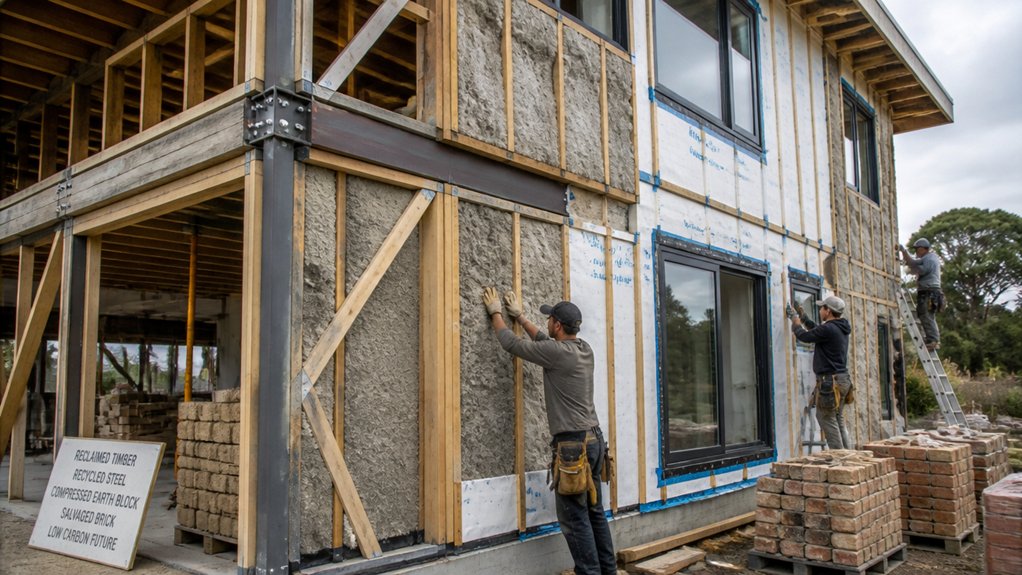
How do you keep reclaimed and recycled materials from becoming the weak link in your building’s envelope and structure? You start with performance targets, then design the assembly to meet them, regardless of material origin. Model whole‑building energy to set insulation, airtightness, and glazing ratios that protect thermal comfort and cut operational carbon.
Control moisture with a defined drainage plane, capillary breaks, and vapor control matched to climate so reused sheathing or masonry can dry safely over decades. Address fire by selecting rated assemblies, limiting concealed cavities, and verifying flame‑spread/smoke performance of reclaimed finishes to protect occupants and Indoor air.
For structure, treat reused steel, timber, and masonry as variable inputs: design to tested properties, include robustness and connection detailing in calculations, and plan for inspection access and future reuse.
Install Reclaimed and Recycled Materials the Right Way
Even if the reclaimed lumber, brick, or steel meets your spec on paper, the install can still make it the failure point if you don’t standardize handling, prep, and sequencing. Stage materials under cover, keep them off slab moisture, and separate lots to avoid cross‑contamination.
Mill and de‑nail wood, chase checks, and predrill to prevent split failures. For masonry, clean faces without over‑etching, then use compatible mortars so salts don’t accelerate spalling.
For salvaged steel, remove corrosion to sound metal, recoat cut edges, and isolate dissimilar metals to stop galvanic attack. Use upcycling techniques like re‑laminating short members into beams, but verify fastener schedules.
Seal end grain, maintain drainage planes, and you’ll extend material durability over the building’s service life.
Document Compliance for Permits, Inspections, and Resale
Because inspectors and future buyers can’t verify what they can’t trace, you need a clear compliance record that ties each recycled component to code requirements and project performance. Build a materials log with source, chain-of-custody receipts, photos, and batch IDs; link each item to relevant Legal regulations (fire rating, structural grading, VOC limits, electrical listings).
Keep manufacturer data sheets, engineering letters for salvaged members, and lab results for contaminants or moisture content. Track installation QC: torque logs, fastener specs, flashing details, and inspection sign-offs. Document Certification standards you claim (FSC Recycled, Cradle to Cradle, UL, EPA).
Store everything in a shareable digital binder with version control. At resale, you’ll prove durability, safety, and embodied-carbon benefits without rework.
Frequently Asked Questions
How Do Recycled Materials Affect Indoor Air Quality and Off‑Gassing?
Recycled materials can improve Indoor air quality if you control contaminants, but they can worsen it when binders, adhesives, or legacy finishes drive Off gassing effects (VOCs, SVOCs).
You’ll reduce risk by specifying low‑VOC resins, formaldehyde‑free composites, and verified recycled content with emissions certifications (CDPH, GREENGUARD).
You should pre‑condition materials, ventilate during install, and commission with IAQ testing to confirm lifecycle performance across occupancy.
Will Using Reclaimed Materials Increase My Home Insurance Premiums?
Usually, reclaimed materials won’t increase your home insurance premiums; they’re like a well‑sorted toolbox—organized, documented, dependable. You’ll keep rates stable when you prove code compliance, Material durability, and certified installation.
Provide receipts, grading reports, and photos, and you’ll reduce underwriting uncertainty.
Address higher‑risk items (old wiring, unknown structural members) with inspections and replacement schedules.
You can even realize Cost savings through discounts for updated systems and documented maintenance plans.
What Warranties Apply to Products Made From Recycled or Reclaimed Materials?
You’ll usually get the same manufacturer warranty as virgin products if the reclaimed content meets Certification standards and the seller documents chain-of-custody.
You should expect shorter or “limited” warranties for salvaged items, often sold as-is, unless you buy through a certified refurbisher.
Verify Material durability with test reports, install requirements, and maintenance schedules.
Register products, keep invoices, and confirm coverage for labor, removal, and performance over time.
Can Recycled Materials Interfere With Smart Home Wiring or Connectivity?
Yes, recycled materials can disrupt smart home signals if you don’t manage circuit interference and wiring compatibility. Metal‑mesh, mixed‑metal, magnet‑making materials can shield Wi‑Fi, detune antennas, or induce noise near low‑voltage runs.
You’ll mitigate risk by segregating power and data, bonding and grounding properly, using shielded cable where needed, and validating pathways with post‑install testing. During upgrades, you’ll document materials to maintain performance.
How Do Recycled Materials Impact Future Renovations or Remodeling Flexibility?
Recycled materials can either boost or limit your remodeling flexibility, depending on documentation and standardization. You’ll gain Design versatility and Aesthetic variety when you use modular reclaimed components with known dimensions.
You’ll face constraints if you install irregular salvage without traceable specs, complicating structural loads, fastening, and code compliance.
You should keep material passports, maintain reversible connections, and plan service chases, so you can adapt layouts, swap finishes, and reduce future waste.
Conclusion
You’ve set clear targets, sourced dependable reclaimed stock, and designed for energy, moisture, fire, and structure. Now you’ll “gently retire” waste by locking performance into every layer—tested fasteners, proper flashing, compatible membranes, and verified load paths. Keep a tight paper trail: chain-of-custody, product data, test reports, and as-builts. That documentation smooths permits and inspections and protects resale. With commissioning and maintenance plans, you’ll extend service life and cut replacement cycles.
About the Author