You choose the perfect garage door by measuring your rough opening, headroom, and side-room, then matching the door to your use cycles and local freeze-thaw or wind-load demands. Pick a style that fits your façade geometry, and choose materials for security and durability—thicker-gauge steel, reinforced composite, or sealed wood. Add polyurethane insulation, full perimeter seals, and quiet rollers. Harden entry points with slide locks, rolling-code openers, force calibration, 2FA, and secure windows. Next, you’ll see how to compare options.
Key Takeaways
- Measure rough opening, headroom, and side-room, and account for seasonal shifts to ensure smooth, safe track alignment and sealing.
- Match door style to your home’s architecture using panel profiles, window layouts, and hardware finishes that enhance curb appeal without weakening structure.
- Choose materials for durability and security: thicker-gauge steel or impact-resistant composite, with reinforced stiles and tamper-resistant hinges and straps.
- Prioritize insulation, weatherstripping, and noise control with high-R panels, bottom seals, nylon rollers, and belt-drive or jackshaft openers.
- Upgrade security and access with rolling-code openers, 2FA smart controls, audit logs, vacation lockout, and high, obscured, laminated windows.
Define What You Need From a Garage Door (Size, Use, Climate)

Before you compare materials, openers, or insulation ratings, you need to define exactly what your garage door must do for your property. Measure the rough opening width, height, and headroom, then confirm side-room for tracks and sensors so the door can’t be forced off-line.
Decide how you’ll use the garage: vehicle bay, workshop, or storage; heavier daily cycles demand higher spring ratings and reinforced panels.
Match climate to performance: choose airtight perimeter seals, wind-load resistance, and insulation levels that control condensation and reduce heat loss.
If you’re in freeze-thaw zones, plan for seasonal adjustments to track alignment, seal compression, and opener force limits.
Build Garage door maintenance into your schedule: test balance, photo-eyes, locks, and manual release monthly.
Choose a Garage Door Style That Fits Your Home

You’ll get better curb appeal and fewer security compromises when you choose a garage door style that matches your home’s architectural design, including panel profile, window layout, and hardware finish.
You should also balance color and materials with the facade so the door doesn’t highlight pry points, exposed fasteners, or flimsy trim contrasts.
If you align style with structure and finishes, you’ll keep sightlines clean while supporting robust construction and secure hardware placement.
Match Architectural Design
How do you pick a garage door style that complements your home’s architecture without creating weak points? Start by mapping the façade’s geometry: roof pitch, window proportions, and trim rhythm should align with panel spacing, rail width, and window lite placement.
If you’ve got a modern elevation, choose flush or long-panel profiles that minimize seams. For traditional homes, raised panels with consistent stiles reinforce visual order without adding vulnerable joints.
Match hardware to structural needs: use concealed hinges or tamper-resistant strap hardware rated for wind load. Specify track radius and spring sizing that suit door height so it seats tightly against the stop.
Plan Garage door maintenance and seasonal adjustments to keep seals compressed, rollers aligned, and locks engaging cleanly year-round.
Balance Color And Materials
While color and material choices can unify the elevation, they also affect security and long-term door integrity. You should match paint and cladding to your exterior, but prioritize finishes that resist UV fade, corrosion, and impact.
Dark colors absorb heat; on steel doors they can accelerate panel warping and stress weather seals, increasing pry points. If you choose wood or faux-wood overlays, confirm the core uses reinforced stiles and tamper-resistant bottom brackets.
Aluminum resists rust but dents easier; select thicker-gauge panels and internal struts. Insulated steel with a baked-on coating often balances curb appeal with forced-entry resistance.
Plan Garage door maintenance: inspect coatings, fasteners, and seal compression. Include seasonal adjustments for spring tension, track alignment, and thermal expansion.
Compare Garage Door Materials (Steel, Wood, Aluminum, Composite)
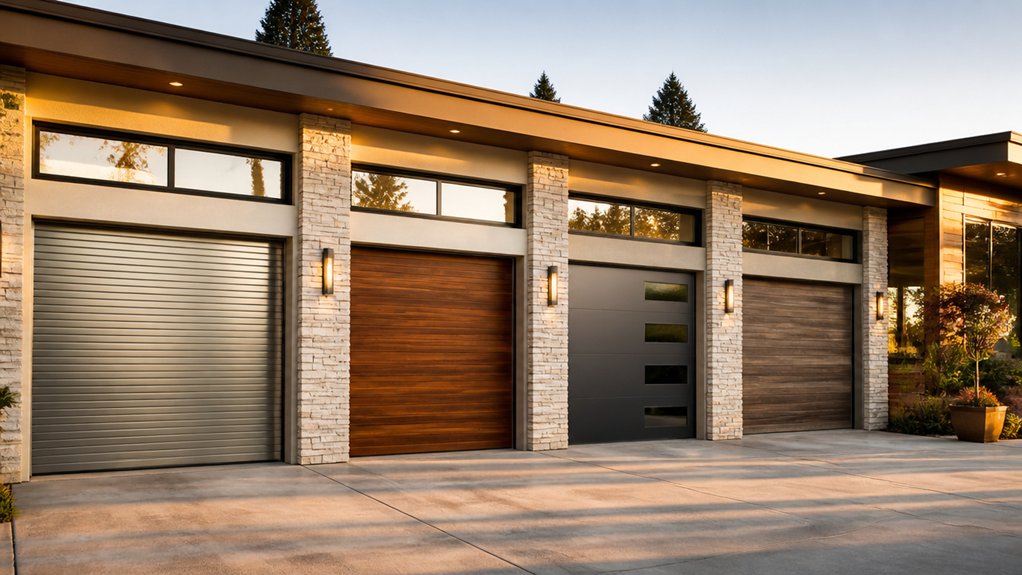
Because the door itself acts as a large, street-facing barrier, the material you choose directly affects forced-entry resistance, denting and corrosion performance, weight on the opener and tracks, and long-term maintenance.
Steel offers the best security-to-cost ratio; choose thicker gauge and reinforced stiles to resist prying, but expect dents and watch cut edges for rust during garage door maintenance.
Wood delivers stiffness and upscale looks for seasonal decor, yet it’s vulnerable to moisture-driven swelling, joint separation, and rot unless you seal and repaint routinely.
Aluminum won’t rust and stays light on hardware, but it’s easier to dent and can deform under leverage.
Composite (steel frame with engineered skins) balances rigidity, impact resistance, and low upkeep, while hiding fasteners and resisting cracking.
Decide on Garage Door Insulation and Noise Control
You’ll want to choose an insulation type—polystyrene panels, polyurethane foam-in-place, or a thermal-break construction—based on how tightly it seals the door and resists forced flexing.
You should verify the stated R-value and look for full-perimeter weatherstripping and bottom seals, because efficiency drops fast when air leaks create predictable gaps.
For noise control, you can prioritize thicker insulated sections, nylon rollers, vibration-isolating hinges, and a belt-drive opener to cut rattle that can advertise activity inside.
Insulation Types Compared
How much insulation and noise control your garage door needs depends on the core material and how it’s installed, not just the advertised R-value.
Polystyrene panels are cost-effective and resist moisture, but they can leave air gaps at stiles and rails, letting sound and pry tools transmit force.
Polyurethane foam bonds to the skin, stiffens the door, and reduces panel drum noise, improving resistance to flexing during forced-entry attempts.
Reflective foil layers mainly block radiant heat; pair them with tight perimeter seals or you’ll still hear street noise.
For security, choose a door with a reinforced strut and insulated end stiles, then verify track alignment and fastener torque.
Plan Garage door maintenance and seasonal adjustments so seals stay compressed and hinges don’t loosen over time.
R-Value And Efficiency
While R-value gives you a quick snapshot of conductive heat loss through the door panel, real-world efficiency depends on the entire assembly—panel joints, perimeter seals, bottom astragal, and track-to-opening alignment.
You’ll get better Energy efficiency when you pair high-R insulation options with tight tolerances that prevent air leakage and pressure-driven infiltration. Specify polyurethane-injected cores for higher R per inch, and choose steel skins with thermal breaks to reduce heat bridging at stiles and rails.
Verify continuous weatherstripping, corner seal integrity, and a reinforced bottom seal that stays in contact across uneven slabs. You should also confirm the opener’s force settings and auto-reverse calibration, since binding from misalignment can compromise seals and increase wear.
Finally, inspect fasteners and hinge points; loose hardware creates gaps.
Noise Reduction Features
Because a garage door functions like a large vibrating diaphragm, the right noise-reduction features depend on both the panel construction and the hardware that drives it.
Choose polyurethane-insulated, steel-sandwich panels to damp resonance and tighten the acoustic seal at the perimeter. Specify double-lip bottom seals, compression side weatherstripping, and an insulated top header seal to block airborne noise and reduce pry points.
For soundproofing options, add mass-loaded vinyl backing or acoustic liners, but guarantee fasteners don’t compromise panel integrity.
Upgrade to nylon rollers with sealed bearings, a belt-drive opener, and soft-start/soft-stop controls; this noise reduction technology limits vibration transfer into framing.
Verify track alignment, torsion-spring balance, and hinge lubrication so the door can’t rattle under forced-entry attempts.
Garage Door Security Features: Locks, Openers, Smart Controls
If you want your garage door to resist tampering as well as forced entry, you’ll need to evaluate the full security stack—mechanical locks, opener drive/logic protections, and smart controls that manage access.
Start with mechanical locking: choose a hardened slide lock or deadbolt-style kit, reinforce the strike, and add an inside shield to block coat-hanger bypass.
Verify the opener uses rolling-code encryption, lockout vacation mode, and a monitored force profile that reverses on obstruction without becoming easy to stall.
Favor DC motors with soft-start sensing and tamper alarms.
For smart controls, enable two-factor authentication, audit logs, and time-bounded guest codes; disable remote access when you’re away.
Prioritize Garage door security features that support smart home integration via secure APIs and local control options.
Pick Garage Door Windows, Decorative Hardware, and Color
Even though windows, decorative hardware, and color read as cosmetic choices, they can either harden your garage door or hand attackers extra leverage and visibility. Choose Garage door window styles that limit sightlines: place glass high, avoid full-view panels, and pick obscure, frosted, or tinted glazing.
Specify impact-rated or laminated glass and use interior glazing beads so thieves can’t pop panes to reach the emergency release. If you need ventilation, avoid louvered inserts that admit tools.
Select decorative hardware options that don’t create pry points. Prefer through-bolted, low-profile handles and hinges with concealed fasteners, or purely magnetic accents on steel doors.
Finish with UV-stable, fade-resistant coatings; darker colors can mask scuffs but heat cycles can stress seals, so verify weatherstrip compatibility.
Estimate Garage Door Cost: Door, Opener, and Installation
While sticker prices tempt you to shop on door style alone, a security-minded cost estimate has to include the door’s construction, the opener’s features, and the installation details that prevent forced entry. Price the door by gauge, insulation R-value, reinforced struts, and tamper-resistant brackets; thicker steel and composite cores raise cost but cut pry risk.
Add opener costs for rolling-code encryption, automatic deadbolt, battery backup, and smart alerts; chain drives run cheaper, while belt and jackshaft units cost more and reduce vibration-based fastener loosening.
Installation isn’t just labor: budget for anchored tracks, hardened fasteners, keyed emergency release shields, and calibrated force limits. Plan Garage door maintenance line items and verify garage door warranties cover panels, springs, and electronics.
Frequently Asked Questions
What Maintenance Schedule Keeps a Garage Door Operating Smoothly Year-Round?
Follow a monthly check: tighten hardware, clean tracks, and test the photo-eyes and auto-reverse.
Every 3 months, lubricate rollers, hinges, and springs with door-rated lubricant, adjusting by Garage door materials (steel needs rust inspection; wood needs sealant checks).
Twice yearly, balance the door, inspect cables, and replace worn weatherstrips.
Annually, schedule a pro tune-up for spring tension, opener force limits, and Security enhancements like lock integrity and keypad audit.
How Long Does a Typical Garage Door Last Before Replacement Is Needed?
A typical garage door lasts 15–30 years before you’ll need replacement, depending on usage cycles, climate, and maintenance. Garage door materials matter: steel often reaches 20–30 years, aluminum 15–25, wood 15–20, and fiberglass/composite 20–30 with proper sealing.
You should replace sooner if panels delaminate, tracks deform, or rust compromises rigidity. Upgrade early when adding Security enhancements like reinforced struts, tamper-resistant brackets, or smart locks.
Do I Need a Permit or HOA Approval to Replace My Garage Door?
Yes—you’ll often need a permit and/or HOA approval, and it isn’t as painful as it sounds. Check your city’s building department for permit triggers like structural changes, new opener wiring, or altered openings; pull permits before scheduling.
Review HOA bylaws for color, window layout, and material rules that affect aesthetic appeal. Document specs, wind-load ratings, and lock hardware to support home security and speed approval.
Can I Retrofit My Existing Door With a New Opener or Smart Features?
Yes—you can usually retrofit your existing door with a new opener and smart technology, as long as the door is structurally sound and properly balanced. You’ll verify opener compatibility (door weight, spring type, track radius) and install a reinforced mounting bracket.
For garage door security, you’ll enable rolling-code remotes, lockout controls, and encrypted app access. Add door-position sensors, auto-close timers, and battery backup to maintain secure operation.
What Warranty Coverage Should I Expect for Parts, Paint, and Labor?
You should expect separate warranties: parts typically 3–10 years, opener motors often lifetime; paint/finish usually 1–5 years against peeling or rust-through; labor commonly 1 year, sometimes 90 days.
You’ll want written exclusions for wind, salt air, impact, and improper lubrication. Confirm coverage transfers to new owners.
Make certain security enhancements (rolling-code remotes, smart modules) have their own terms.
Garage door aesthetics coverage rarely includes fading.
Conclusion
When you choose your garage door, you’re balancing style, thermal performance, and attack resistance in one system. Match size and duty cycle to your vehicles, then select materials and insulation that fit your climate and noise tolerance. Prioritize hardened locks, rolling-code or encrypted openers, and monitored smart controls with secure permissions. Finish with windows, hardware, and color that don’t compromise privacy. A well-specified door is your home’s shield.
About the Author