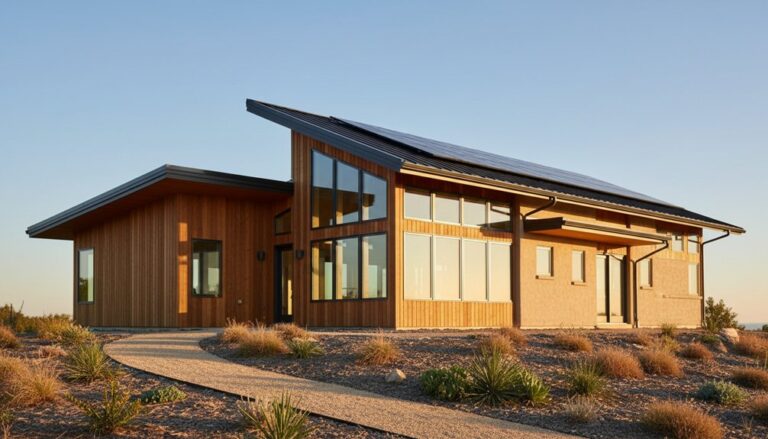
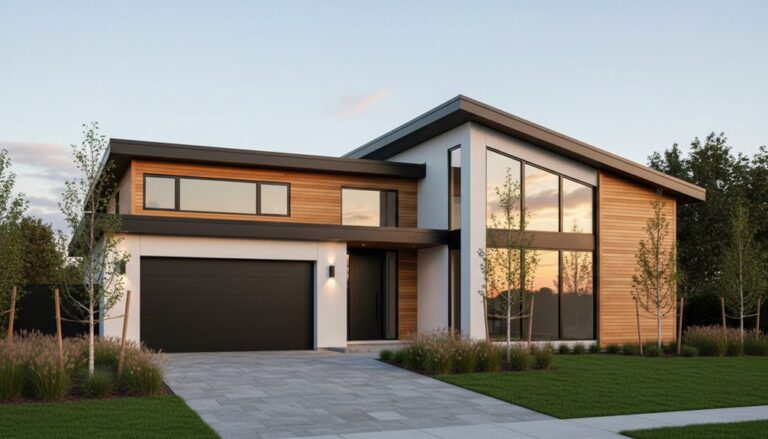
You build a modern eco home by setting measurable targets (EUI, ACH50, VOC caps) and budgeting for envelope upgrades, commissioning, and blower-door testing. You then rank materials with verified EPDs (kg CO₂e per m²) and choose low-carbon assemblies like SCM concrete, FSC timber, recycled metals, and cellulose or wood-fiber insulation with continuous exterior layers. You protect IAQ with CDPH-tested low-VOC finishes and design rainscreens, service cavities, and mechanical fixings for durability and reuse. Keep going to see how to verify certifications and prevent substitutions.
Key Takeaways
- Set measurable eco goals for EUI, airtightness, VOC limits, and water use, with budget line items for testing and commissioning.
- Choose materials using verified EPDs, comparing like-for-like assemblies by embodied carbon, durability, maintenance cycles, and end-of-life pathways.
- Verify certifications are third-party audited, current, and ISO 14024/EN 15804 aligned, avoiding vague self-declared “eco” labels.
- Prioritize low-carbon structures and insulation like SCM concrete, FSC mass timber, recycled metals, cellulose, cork, and continuous exterior insulation.
- Design for airtightness and indoor air quality using taped membranes, blower-door testing, low-VOC finishes, and balanced ventilation with controlled curing humidity.
Set Eco Goals and a Sustainable Materials Budget

Before you spec a wall assembly or price a slab, define measurable eco targets and tie them to a materials budget you can actually execute. Set EUI and airtightness thresholds, a recycled-content minimum, and a VOC cap you’ll verify with product data sheets and third-party labels.
Assign line items for envelope upgrades, low-impact insulation, and durable finishes, then include allowances for commissioning and blower-door testing so performance claims aren’t theoretical.
Model operational loads and reserve budget for Renewable energy readiness: conduit paths, roof load capacity, inverter space, and an electrical panel sized for electrification.
Quantify Water conservation with a fixture-flow schedule, hot-water distribution limits, and submetering provisions.
Track alternates, lead times, and cost-per-performance to prevent last-minute substitutions.
Rank Sustainable Materials by Carbon and Impact

You’ll rank candidate materials by quantified embodied carbon (kg CO₂e per kg or per m²) using verified EPDs so you can compare like-for-like assemblies.
Then you’ll layer in lifecycle impact ranking—durability, maintenance cycles, recyclability, and end-of-life pathways—so low-carbon picks don’t hide higher downstream burdens.
With those metrics, you can prioritize substitutions (e.g., SCM concrete, mass timber, recycled metals, cellulose insulation) that minimize total impact while still meeting structural and performance specs.
Embodied Carbon Comparison
Although operational efficiency drives long-term emissions down, the materials you specify lock in embodied carbon on day one, so it’s worth ranking options by verified global warming potential (kg CO₂e) per functional unit using EPD-backed data and the project’s actual quantities.
Compare like-for-like: 1 m² of wall at target R-value, 1 m² of slab, or 1 linear meter of beam at design load.
Typical rankings put bio-based assemblies (straw, hemp-lime, FSC timber) lowest, mineral wool and cellulose mid, and steel, aluminum, and Portland-cement-heavy concrete highest.
You’ll see big swings from cement content, recycled scrap ratios, and kiln fuels.
Specify SCMs, high-recycled metals, and low-carbon concrete mixes to cut material impact while meeting strength, fire, and moisture requirements.
Track transport distances separately.
Lifecycle Impact Ranking
How do you rank “sustainable” materials when carbon is only one slice of the footprint? You’ll need a lifecycle impact score that combines embodied emissions, durability, toxicity, water use, and end-of-life outcomes.
Start with EPD-backed data to normalize impacts per functional unit (e.g., kg CO₂e per m² at 60-year service life). Then adjust for maintenance cycles: fiber-cement, brick, and metal roofing often beat short-lived composites despite higher upfront carbon footprint.
Next, factor material recyclability and circular pathways. Favor aluminum with high recycled content, steel with take-back programs, and mass timber from certified forests with documented biogenic carbon handling.
Penalize PVC, mixed-material laminates, and foams that contaminate recycling streams or off-gas. Your ranking should reward repairability, disassembly, and verified low-impact supply chains.
Sustainable Structural Materials (Frame, Slab, Roof)

Because the frame, slab, and roof carry most of a home’s embodied carbon and durability risk, material selection here drives the project’s real sustainability performance. Specify EPD-backed products and compare kgCO2e per m² alongside service life and maintenance pathways.
For framing, you can cut impacts by using Recycled steel with high scrap content and electric-arc-furnace production; you’ll also gain dimensional stability and precise tolerances that reduce waste.
Where codes allow, Bamboo framing offers rapid-renewal feedstock and strong specific strength, but you must verify adhesive chemistry, moisture detailing, and third-party structural grading.
For slabs, reduce cement with SCM blends (slag, calcined clay) and optimize rebar with recycled content.
For roofs, choose FSC timber or recycled-metal panels, prioritize long-life coatings, and design for disassembly.
Sustainable Insulation and Airtightness Materials
Once you’ve lowered the embodied carbon in the frame, slab, and roof, insulation and airtightness become the fastest way to cut operational energy without locking in high‑GWP materials.
Specify cellulose, wood fiberboard, cork, or Natural fiber batts; they deliver competitive R-values, store biogenic carbon, and often tolerate transient moisture better than petrofoam.
Detail continuous exterior insulation to reduce thermal bridges, then target airtightness with taped sheathing membranes, gaskets at framing junctions, and airtight electrical/pipe boots.
Use smart vapor barriers or variable-perm membranes where climate and assembly require drying potential; avoid polyethylene unless hygrothermal modeling supports it.
Commission with blower-door testing, then fix leaks at rim joists, top plates, and penetrations to hit low ACH50 reliably.
Low-Tox Paints, Floors, and Sealants (IAQ Wins)
Even if you’ve nailed airtightness, finishes can dominate indoor air quality when paints, adhesives, and sealants off-gas VOCs, SVOCs, and isocyanates during curing and for months afterward. Choose Low VOC formulations: waterborne acrylic or mineral silicate paints, and avoid added formaldehyde, glycol ethers, and fragrance.
For floors, specify solid wood or linoleum with mechanical fastening, or use click-lock products to reduce adhesive load. If you need glue, select water-based, solvent-free, and isocyanate-free options.
Sealants matter at trim, baths, and penetrations: use neutral-cure silicone or silyl-modified polymer rather than polyurethane where possible. Let materials acclimate, keep humidity controlled, and run continuous ventilation through cure to accelerate emission decay and protect occupants.
Certifications and EPDs to Avoid Greenwashing
To avoid greenwashing, you’ll treat an Environmental Product Declaration (EPD) as a transparent, third-party-verified LCA record—check the PCR used, system boundaries (A1–A3 vs. A1–C4), data quality, and comparability before you benchmark materials.
You’ll also vet eco certifications by confirming the standard, certification scope (product vs. facility), audit frequency, and whether VOC emissions, chemical content, and recycled or biobased claims are independently tested.
When you read these documents critically, you can specify products based on quantified impacts and verified attributes instead of marketing language.
Understanding EPD Transparency
Because low-carbon claims can hide behind vague labels, you’ll want to treat Environmental Product Declarations (EPDs) as your primary evidence trail for building materials. Start by checking whether the EPD is product-specific, current, and third-party verified, then confirm it follows ISO 14025 and EN 15804 so results stay comparable.
For epd transparency, read the declared unit, system boundary (A1–A3, A4–A5, B, C, D), and data quality notes. You should expect clear material disclosure: bill-of-material ranges, recycled content methodology, additives, coatings, and any excluded inputs.
Review impact indicators beyond GWP—acidification, eutrophication, smog formation, and resource depletion—so you don’t optimize carbon while worsening toxicity or durability. Finally, compare multiple EPDs using the same PCR, and flag missing uncertainty or cut-off rules.
Spotting Credible Eco Certifications
EPDs give you quantified impacts, but they don’t guarantee a product meets health, sourcing, or performance thresholds—so you also need to vet the certifications wrapped around those numbers.
Start by checking whether the label follows ISO 14024 or EN 15804-aligned Eco label standards and whether it references a published product category rule.
Verify third-party auditing, chain-of-custody controls for wood, and test methods for VOC emissions (e.g., CDPH v1.2) and formaldehyde.
Read the scope: does it cover the exact SKU, plant, and geography shown on the EPD?
Scrutinize Certification processes for transparency: public criteria, complaint mechanisms, renewal intervals, and surveillance audits.
Avoid vague “eco” seals, self-declared badges, and certificates without certification body accreditation or dated documentation.
Design for Durability, Repair, and Material Reuse
When you design an eco home for longevity, you cut embodied carbon by extending service life and keeping high-impact materials in use longer. Specify assemblies with proven Durability testing data: freeze–thaw resistance for masonry, ASTM abrasion ratings for flooring, and corrosion performance for fasteners in your local exposure class.
Detail drainage planes, capillary breaks, and ventilated rainscreens so moisture doesn’t drive rot or mold. Make repair easy: use mechanical fixings instead of permanent adhesives, keep service cavities accessible, and standardize dimensions so parts swap without demolition.
Choose finishes you can refinish, not replace—oiled timber, lime plasters, and demountable cladding. Plan for Material reusability by selecting mono-material layers, avoiding composite laminates, and documenting components in a material passport for future salvage and resale.
Frequently Asked Questions
How Do I Secure Financing or Rebates for Sustainable Home Construction?
You secure financing or rebates by documenting performance targets and matching them to green financing products and rebate programs. Get a HERS rating projection, energy model, and itemized specs for insulation R-values, window U-factors/SHGC, HVAC SEER/HSPF, and heat-pump water heater UEF.
Pre-apply before permits. Ask lenders about energy-efficient mortgages or green construction loans.
Then submit invoices, commissioning reports, and blower-door results to claim incentives. Verify eligibility dates.
What’s the Best Way to Vet a Contractor’s Experience With Eco Materials?
Vet their eco-material experience by treating the interview like a lab audit—it’s a billion-times smarter than guessing.
Ask for Eco certification, plus contractor credentials tied to specific assemblies (air barriers, WRBs, cellulose, FSC lumber).
Require three project addresses and blower-door, moisture, and VOC test reports.
Call references about defect rates and change orders.
Review submittals: SDS sheets, EPDs, and installation details.
Verify training with manufacturers and confirm waste-diversion logs.
How Long Do Sustainable Materials Typically Take to Source and Deliver?
You can typically source and receive sustainable materials in 2–12 weeks, but it varies by product and certification.
Material sourcing for FSC lumber or low-VOC finishes often runs 2–6 weeks if stocked.
Reclaimed timber, specialty insulation, or custom windows can push 8–16 weeks.
Delivery timelines tighten when suppliers provide chain-of-custody docs and third-party EPDs; those checks add days to a week.
Order early, confirm lead times weekly.
Will Sustainable Choices Increase Resale Value or Improve Appraisal Outcomes?
Yes—if you document performance and choose market-recognized systems, you’ll often see improved appraisal outcomes and measurable resale benefits.
Appraisers can credit ENERGY STAR/HERS data, verified insulation R-values, airtightness tests, and durable low-VOC finishes when comps support it.
Green certifications (LEED, NGBS, Passive House) add third-party validation that reduces perceived risk.
You’ll capture more value with upgraded windows, heat pumps, and renewables than niche materials alone. In most markets.
What Ongoing Maintenance Costs Differ for Eco Homes Versus Conventional Homes?
You’ll often pay less for utilities but more for specialized upkeep. High-performance envelopes need periodic air-seal checks, filter swaps, and balanced-ventilation servicing.
Heat pumps and ERVs typically cost more to repair, while PV inverters may need replacement around 10–15 years.
Landscaping costs can drop with native, drip-irrigated systems, yet permeable paving needs vacuuming.
You’ll also budget for periodic Energy efficiency upgrades as standards and controls evolve.
Conclusion
You’ve set clear eco goals, priced priorities, and picked products by proven carbon data. You’ll favor fast-renewing frame and roof systems, low-cement slabs, and high-R insulation that’s airtight and moisture-smart. You’ll finish with low-VOC paints, floors, and sealants that protect IAQ. You won’t fall for fuzzy claims—verify EPDs and certifications. Finally, you’ll design for durability, disassembly, and reuse, so your home stays strong, safe, and sustainable.
About the Author