Minimalist garage doors carry architectural gravitas because you perceive them as a single, calm plane, not a busy product. You get clean edges, tight reveals, and hardware that disappears, so the door reads like part of the building mass. When you align seams and rails to your façade grid, proportions start to control rhythm and scale. Calibrated recesses and shadow lines add depth through absence and light. Next, you’ll see how materials and maintenance choices sharpen that effect.
Key Takeaways
- Clean, uninterrupted panels reduce visual noise, making the door read as a calm architectural plane rather than a busy product.
- Integrated materials and concealed hardware turn the door into façade massing, lending weight, permanence, and intentionality.
- Strong proportions and alignment with windows or cladding joints reinforce façade rhythm, so the door supports composition instead of competing.
- Crisp reveals and shadow lines define volume through light and absence, creating depth and precision with minimal elements.
- Restrained palettes and high-quality finishes add subtle material presence, projecting discipline, durability, and quiet authority.
What Defines a Minimalist Garage Door, Visually?

If you strip a garage door down to its essentials, a minimalist design reads as a single, calm plane with clean edges and almost no visual noise. You see broad, uninterrupted panels, tight reveals, and hardware that disappears or aligns with the door’s geometry.
Material choices stay honest: smooth steel, flat aluminum, or fine-grain wood with a sealed, even sheen that catches light without sparkle. Your Color palettes stay restrained—soft whites, warm grays, deep charcoals, or muted timber tones—so the door supports the façade instead of competing with it.
You keep Decorative accents sparse: a single shadow line, a thin vertical seam, or a modest band of frosted glazing that reads as a quiet cut in the surface.
What Makes a Minimalist Garage Door Feel Architectural?

A minimalist garage door turns architectural when it stops reading as a product panel and starts behaving like part of the building’s massing. You get there by choosing materials with real presence: flush steel with a tight grain, sealed timber with restrained figure, or fiber-cement that holds a matte, mineral depth.
You reinforce that effect through color palettes that sit inside the façade’s broader field—tonal blacks, warm grays, or desaturated stains that absorb glare and quiet the street-facing plane. Then you rely on installation techniques that erase evidence of assembly: concealed fasteners, clean perimeter seals, recessed tracks, and disciplined hardware.
When you reduce visual noise, the door reads as a deliberate surface and a calibrated void, shaping how light skims, shadows collect, and the entry sequence feels.
How Do Proportions and Alignment Change the Façade?
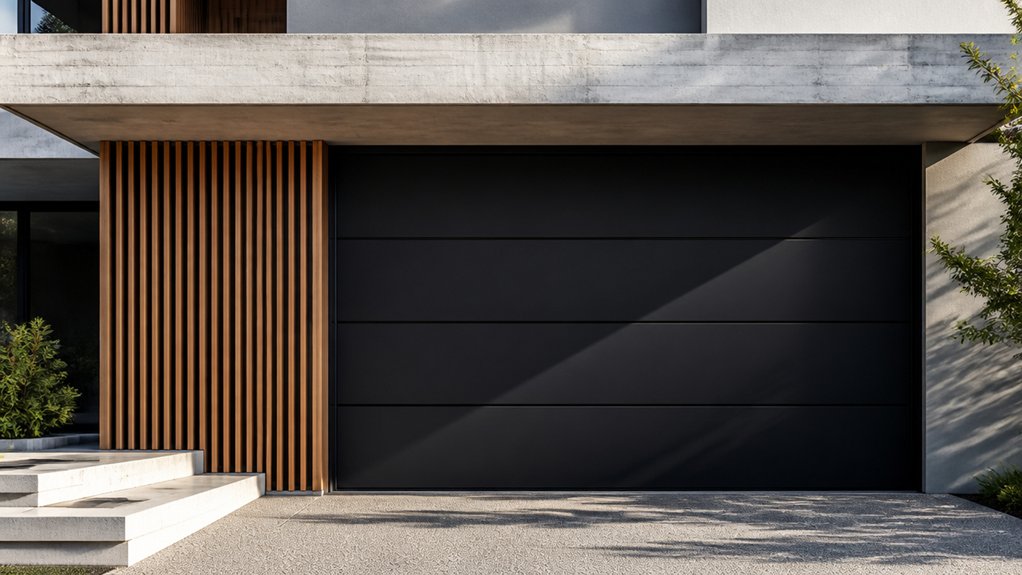
Because the garage door often occupies the largest uninterrupted plane on the front elevation, its proportions and alignment set the façade’s rhythm more than the entry itself.
When you widen the door, you stretch the house laterally, making it read calmer and more grounded; when you heighten it, you add vertical pull that can fight the roofline.
Align the top rail with window heads, and you lock elements into a single datum that feels intentional.
Match jamb lines to cladding joints or column grids, and the composition tightens.
Use Color contrast to control perceived scale: a darker door recedes, a lighter one advances.
Add Texture variation sparingly—fine grain, matte metal—to keep the plane legible while enriching it up close.
Why Do Reveals and Shadow Lines Matter Most?
You control the façade’s tempo when you set reveal depth, because each recess creates a crisp rhythm across metal, wood, or composite planes. You let shadow lines do the heavy lifting, cutting clean edges that make the door read as a single mass or a layered assembly.
You’ll see that a few millimeters of setback can shift the whole space, tightening junctions and sharpening the building’s silhouette.
Reveal Depth And Rhythm
Even if the door panel stays perfectly flat, the reveals—the deliberate gaps, steps, and shadow lines—do most of the visual work. You control depth like a section drawing: a 3 mm setback reads as crisp tolerance; a 15 mm recess becomes a miniature threshold. That calibration turns the door from blank plane into measured façade.
When you repeat reveals, you set rhythm against the house’s grid: align joints to window mullions, course lines, or cladding seams, and the door locks into the elevation. Your Artistic expression comes from editing intervals, not adding ornament.
Material innovation shows up in how you hold those edges—extruded aluminum trims, folded steel returns, CNC-routed timber—so gaps stay straight, durable, and intentionally proportioned across seasons.
Shadow Lines Define Mass
Rhythm sets the cadence, but shadow lines give a minimalist garage door its weight. You’re not decorating; you’re carving volume with absence. A crisp reveal throws a controlled band of darkness that reads like a structural joint, tightening the plane and making the slab feel thicker than it is.
You tune perception through proportion: deepen the gap and the door retreats; narrow it and the facade locks into a single monolith. Color contrast amplifies the cut—dark anodized trims against pale stucco, or blackened steel against cedar.
Texture variation does the same: smooth panels beside split-face masonry sharpen the shadow edge. When you align these lines to window heads and soffits, you anchor the door in the building’s grid, not the driveway.
Which Materials Look Premium: and What Do They Cost to Maintain?
While a minimalist garage door reads as a single, calm plane, the material choice determines whether that plane feels genuinely premium—and how much upkeep it demands year after year.
Among garage door materials, powder-coated steel gives you the crispest shadow and the most stable color; you’ll mostly budget for occasional washdowns and touch-up chips, keeping Maintenance costs low.
Aluminum feels lighter and razor-thin at the edges, but it dents easier, so repairs can spike.
Real wood delivers unmatched depth and warmth as light rakes across grain, yet it asks for sanding, sealing, and vigilance against moisture at the slab’s bottom edge.
Composite or faux-wood panels mimic that richness with tighter tolerances and fewer refinishes, trading authenticity for predictable upkeep.
Glass reads gallery-clean, but you’ll clean it constantly to keep the plane intact.
How Do You Choose a Minimalist Garage Door for Your Home’s Style?
Because a minimalist garage door acts like a single architectural surface, you should choose it the way you’d choose cladding: match its plane, sheen, and detailing to the massing and lines of your home. Read the façade’s geometry first—horizontal courses favor wide-panel or flush designs, while vertical bays pair with tight reveals and tall proportions.
Then tune Garage door textures to distance and light: matte metal recedes, satin glass catches sky, wood grain warms hard edges. Keep hardware quiet; let shadow gaps do the work.
Use Color palettes to either disappear the door into siding or frame it as a deliberate void—charcoal against stucco, bone against brick. Finally, align window lites with interior sightlines so the door reinforces the house’s spatial rhythm, not noise.
Frequently Asked Questions
Do Minimalist Garage Doors Improve Home Resale Value or Curb-Appeal ROI?
Yes—you can boost resale value and curb-appeal ROI with minimalist garage doors, because you sharpen the facade’s read and modernize the street-view composition.
You’ll get the best returns when you choose durable Garage door materials like steel, aluminum, or composite that hold crisp lines and consistent finish.
You also cut Maintenance requirements with smooth panels and hidden hardware, so buyers perceive less future hassle and a cleaner, more intentional exterior.
How Much Do Minimalist Garage Doors Reduce Street Noise and Drafts?
You might assume a “minimal” door can’t buffer much, but you’ll often cut street noise by about 3–10 dB and noticeably reduce drafts when you choose insulated panels, tight perimeter seals, and a quality bottom gasket.
For better sound insulation, you’ll want polyurethane cores, thicker skins, and fewer rattling parts.
For draft reduction, you’ll want to tune the track, close gaps, and keep the threshold continuous, so the garage feels calmer.
Are Minimalist Doors Compatible With Smart Openers and Security Systems?
Yes—you can pair minimalist doors with smart openers and security systems. You’ll want Smart compatibility via Wi‑Fi or hub modules, plus encrypted rolling codes and app control.
Choose a clean, flush panel in steel, aluminum, or composite; you’ll hide sensors and wiring in the jambs and ceiling plane so the elevation stays quiet.
For Security integration, add contact sensors, camera lighting, and alerts that map onto your home system.
What Local Permits or HOA Rules Commonly Restrict Minimalist Garage Doors?
You’ll often face local zoning limits on door height, setback visibility, window percentages, and lighting spill.
Plus, there are permit reviews for structural framing, wind load, and fire separation.
Your HOA may enforce aesthetic guidelines: approved colors, flat-panel proportions, glazing opacity, and hardware visibility so the facade reads cohesive.
If you switch to steel, wood, or glass, they can require sample submittals and restrict reflectivity to protect streetscape depth.
How Quickly Can a Minimalist Garage Door Be Installed and Commissioned?
Swift, seamless setup: you can install and commission a minimalist garage door in 4–8 hours for a straightforward swap.
Custom builds take 2–6 weeks including fabrication, then a half-day fit.
Your Installation timeline hinges on Garage door materials—steel and aluminum arrive faster; wood, glass, or flush composite often require lead time.
You’ll schedule framing checks, track alignment, opener programming, safety sensor tests, and final balancing so the door moves quietly, cleanly.
Conclusion
You choose a minimalist garage door and it becomes your home’s quiet monolith: a single plane that steadies the whole façade. You align its seams with windows, and the street reads order, not clutter. You keep the reveal tight, and shadow turns into a drawn line—architecture in graphite. You pick metal, timber, or composite for honest texture, then maintain it like a ritual. In that restraint, your house gains weight.
About the Author