Update your garden by zoning it around your daily routine, then run a 1.2–1.5 m circulation spine to connect dining, lounge, and utility areas without pinch points. Lay large-format porcelain or honed concrete pavers with 1–2% fall away from the house, plus permeable sub-base and channel drains where runoff concentrates. Add 450–600 mm raised beds aligned to window sightlines, and layer low-glare warm LEDs for guidance and ambience. Next, integrate a hidden-reservoir water feature and louvered shade. Keep going to refine materials, levels, and details.
Key Takeaways
- Plan the garden like an outdoor floor plan, linking key zones with a 1.2–1.5 m circulation spine and clear sightlines.
- Upgrade paving with large-format porcelain or honed concrete, minimal joints, and a 1–2% fall away from the house.
- Add contemporary raised beds using steel or concrete with shadow gaps, sized for easy reach and built-in drainage.
- Introduce an architectural water feature with hidden reservoir, efficient magnetic-drive pump, and LED accents for modern nighttime impact.
- Modernize comfort with corrosion-resistant furniture, solution-dyed acrylic textiles, and a louvered pergola or canopy for adjustable shade.
Plan Modern Garden Zones for Your Routine
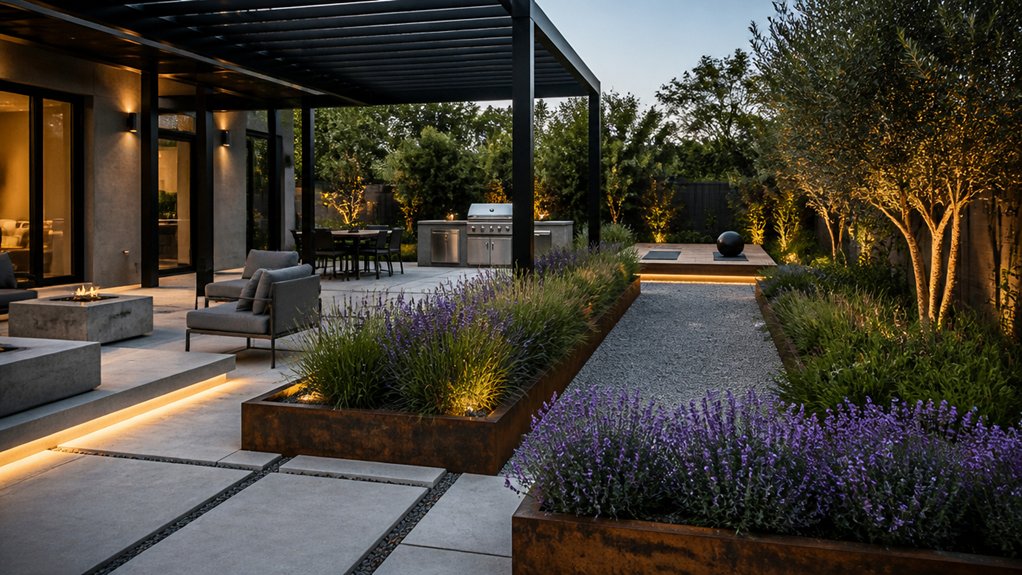
If you map your daily pattern before you buy a single feature, you can zone the garden to work like an outdoor floor plan.
Start at the back door: set a 1.2–1.5 m circulation spine that connects cooking, dining, and lounge nodes without pinch points.
Use sightlines from key indoor windows to anchor focal zones and screen utilities.
Place the dining zone where afternoon shade or a pergola can be added later, and keep it within 6–8 m of the kitchen for fast service.
Define a quiet zone with planting mass and a 900 mm access path for maintenance.
In your garden layout, size each zone to the outdoor furniture footprint plus 600 mm clearance for chairs and circulation.
Choose Modern Paving for Clean Lines and Drainage
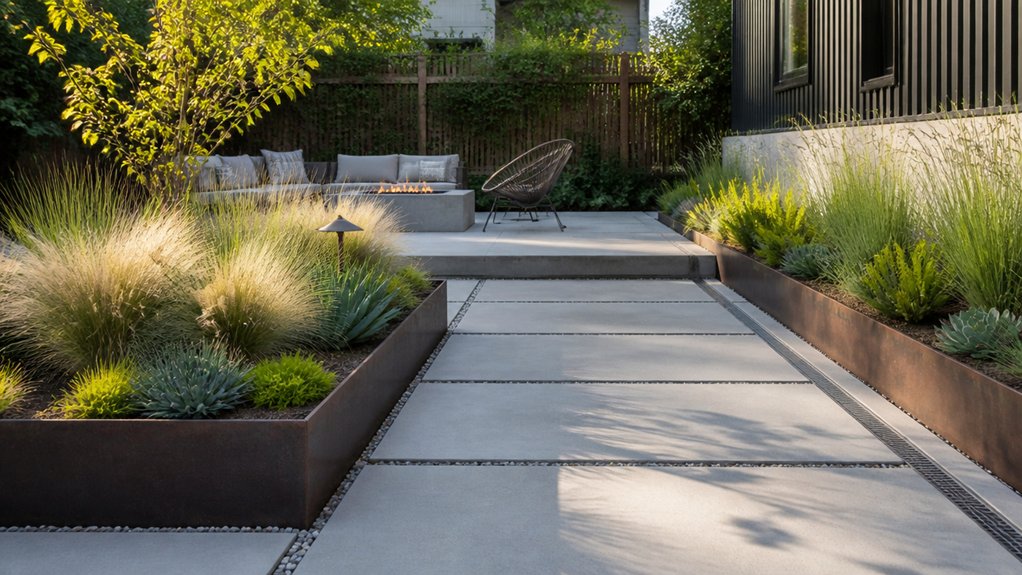
Because paving sets the geometry and water behavior of the whole scheme, choose a contemporary surface that delivers crisp joint lines while draining predictably away from the house.
Set your finished levels first: keep thresholds 150 mm above paving, then fall the surface 1:60 to 1:80 away from walls.
Use large-format porcelain or honed concrete for minimal joints; specify 3–5 mm spacers and a resin grout to hold alignment.
Select paving patterns that reinforce sightlines—stack bond for linear runs, offset bond to disguise slight level changes.
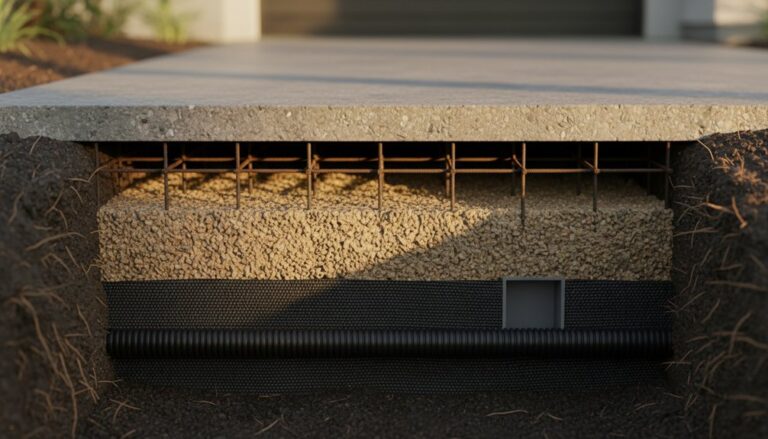
Build reliable drainage solutions: a permeable sub-base, geotextile separation, and a channel drain at pinch points.
Detail edge restraints in steel or concrete to prevent creep.
Specify slip rating for shaded zones.
Install Contemporary Raised Beds for Crisp Structure
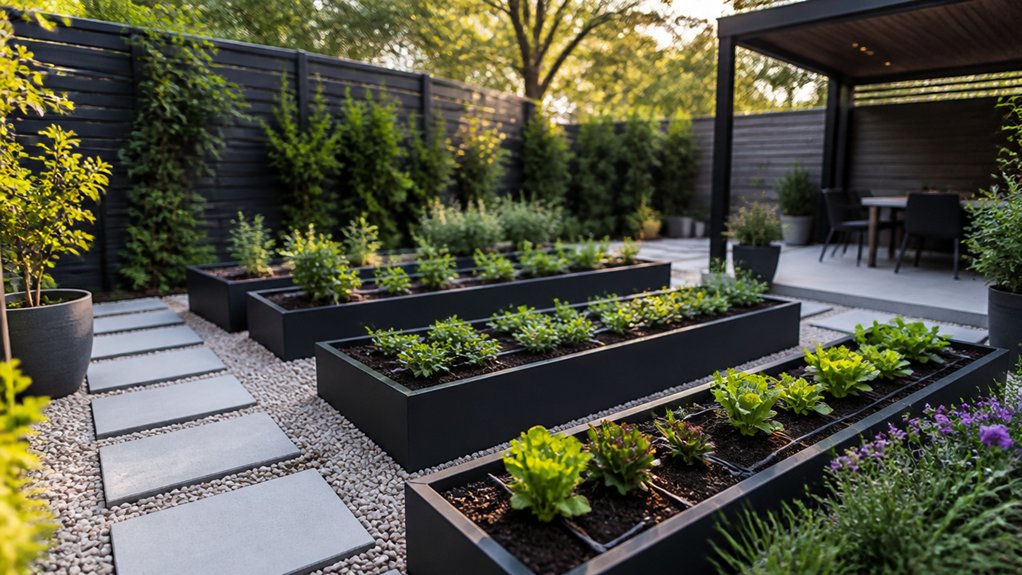
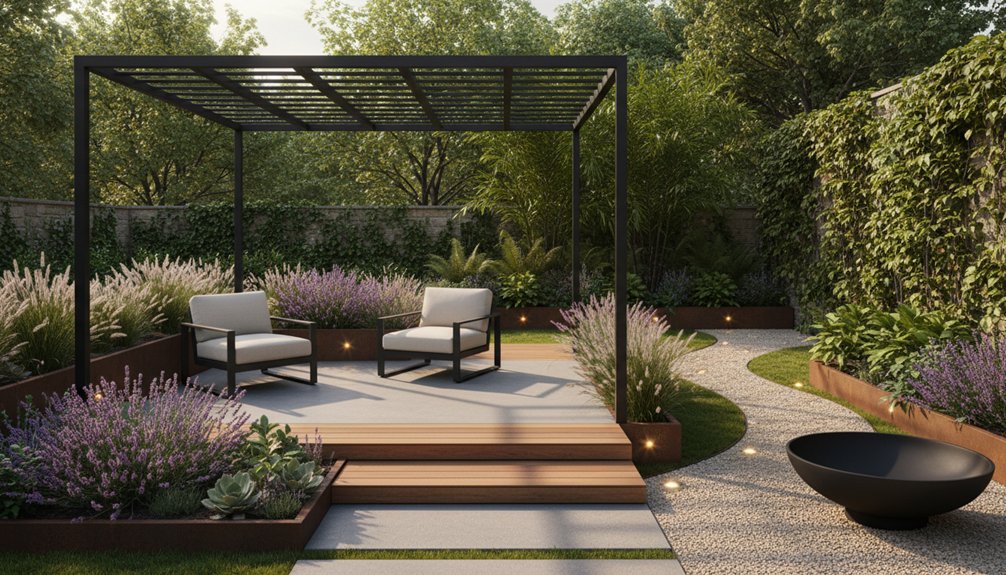
Once your paving lines and falls are locked in, set raised beds to echo that geometry and sharpen the garden’s structure. Run bed edges parallel to primary sightlines from doors and key windows, keeping consistent offsets so joints read intentional. Use powder-coated steel or honed concrete for tight corners and minimal cap profiles; specify 3–5 mm shadow gaps to float walls above paving.
Size beds to your maintenance reach: 1.0–1.2 m max width for access, 450–600 mm height for root volume and seating. Detail drainage with a free-draining sub-base, perforated pipe to soakaway, and a geotextile separator. Fill with layered topsoil and compost matched to Contemporary planting palettes.
For thresholds and patios, add Modern container choices that repeat bed finishes and soften progressions.
Place Smart, Low-Glare Modern Garden Lighting
You’ll get a cleaner nightscape when you specify low-glare fixtures—shielded, warm-LED path lights and downlights that keep the light source out of sightlines from key viewing angles.
Layer your lighting by zoning task, path, and accent runs so circulation stays legible and steps, edges, and grade changes read clearly without hotspots.
Set mounting heights and beam spreads to wash hardscape and planting planes evenly while limiting spill into neighbors and sky.
Choose Low-Glare Fixtures
While contemporary garden lighting can sharpen sightlines and highlight textures, glare will flatten the scene and strain your eyes, so start by specifying low-glare fixtures with deep-set LEDs, frosted lenses, and tight cutoffs. You’ll get cleaner edge control along gravel joints, corten planters, and stone risers without hot spots reflecting off wet leaves.
Choose shielded path heads or micro downlights with a 30–40° beam, then verify UGR-style comfort by viewing from primary seating and entry angles.
For ambient illumination, favor warm 2700–3000K sources with high CRI so bark, masonry, and foliage read true.
Specify marine-grade aluminum or 316 stainless, gasketed lenses, and UV-stable coatings to protect fixture durability in irrigated beds and coastal air.
Layer Lighting For Safety
Because a contemporary garden reads best when light follows circulation, layer your lighting into task, guidance, and ambient zones to keep steps and shifts legible without raising overall brightness.
Place task light at grill counters, gate latches, and potting benches using shielded downlights aimed 30–45° to cut glare.
Use guidance lighting to trace paths and edges: low bollards on the planting side, step lights recessed into risers, and under-cap LEDs on retaining walls, spaced to avoid scalloping.
Reserve ambient light for focal structure—uplight a specimen tree from outside the dripline, or wash a rendered wall with grazers set off the surface.
Balance security concerns with aesthetic considerations by keeping dark corners visible yet avoiding overlit sightlines.
Add a Low-Maintenance Modern Water Feature
You’ll sharpen the garden’s contemporary lines by specifying a slim wall scupper, linear rill, or basin-less bubbler that fits your hardscape grid and viewing angles.
You can keep upkeep low by choosing sealed GFRC, stainless steel, or dense basalt with integrated access panels and a hidden auto-fill.
You’ll also want a quiet, high-efficiency magnetic-drive pump sized to your head height and flow rate, mounted on vibration isolation with a cleanable prefilter for reliable circulation.
Sleek Water Feature Styles
Once you set a clean architectural baseline in the yard, a sleek water feature can sharpen the composition without adding weekly upkeep. Choose a rectilinear rill that tracks a paving joint, or a mirror-like basin that anchors the main view from your kitchen glazing.
For tight patios, specify a wall spillway aligned to a fence bay so the sound projects inward, not at neighbors.
Refine Fountain aesthetics by keeping the water plane flush to coping and hiding the reservoir below grade. In Water flow design, target a laminar sheet or low-turbulence return to reduce splash and wind loss.
Place the pump access under a removable grate, and set the waterline with an auto-fill valve. Integrate LED slots under the lip so nighttime reflections read as clean lines.
Easy-Care Material Choices
Keep the water feature’s lines sharp over time by specifying materials that shrug off scale, staining, and UV without special care. Use cast concrete with an integral pigment, then seal it with a penetrating silane so splashes don’t darken the face.
For a lighter profile, choose powder-coated aluminum basins and scuppers; you’ll avoid corrosion and keep crisp edges.
Line the catch area with smooth black EPDM or preformed HDPE so you can wipe mineral film without scrubbing grout.
Detail coping with a drip edge and hidden stainless shims to prevent water tracking onto adjacent paving.
If the feature borders composite decking, maintain a 10 mm expansion gap and a discreet drainage slot.
Where it meets synthetic turf, set a flush concrete mow strip to stop migration and simplify rinsing.
Quiet, Efficient Pump Systems
Because pump noise reads louder in a hardscaped courtyard than it does in a planted bed, spec a high-efficiency, variable-speed magnetic-drive pump and tuck it into a vented, lined service box below grade.
Run flexible PVC with sweep elbows to cut turbulence, then mount the pump on a neoprene pad for added noise reduction.
Size flow to the feature: a thin weir wants laminar sheet, while a bubbling basalt column needs just enough lift to break surface tension.
Add a check valve and union fittings so you can service without draining the basin.
Pair a skimmer basket with an auto-fill and overflow tied to a gravel drywell to stabilize water level.
You’ll get energy efficiency, clean acoustics, and fewer clogs year-round.
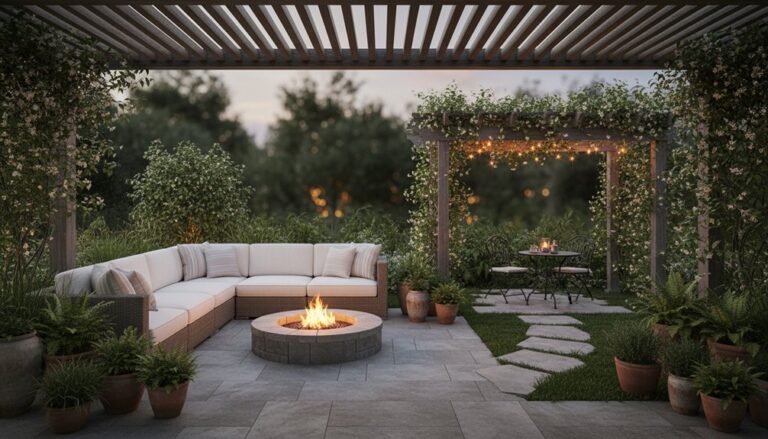
Build a Weatherproof Contemporary Outdoor Lounge Area
If your patio sits exposed to rain, UV, and temperature swings, you’ll need to design the lounge area as a layered, weatherproof system rather than a set of loose furnishings.
Start with drainage: pitch paving 1–2% away from the house, and specify open-joint pavers over a permeable base so splashback can’t pool under seats.
Anchor Garden furniture on stainless or powder-coated frames, with adjustable feet to clear wet surfaces.
Use Outdoor textiles rated solution-dyed acrylic with welded seams and quick-dry reticulated foam; add a breathable cover to stop mildew.
Create overhead control with a louvered pergola or tensioned canopy, then screen wind with slatted panels.
Finally, route low-voltage lighting in conduit and elevate outlets above grade for code-compliant reliability year-round.
Frequently Asked Questions
How Much Does a Contemporary Garden Update Typically Cost?
You’ll typically spend $5,000–$25,000 for a contemporary garden update, depending on size, grading, and material specs.
You’ll pay more if you add hardscape, drainage, and electrical runs for Garden lighting.
Keep costs efficient by using modular pavers, prewired low-voltage fixtures, and standardized plant palettes.
Allocate 10–20% for design and permits.
Plan $1,500–$8,000 for durable Outdoor furniture with marine-grade hardware.
Do I Need Planning Permission for Outdoor Structures or Water Features?
You don’t always need planning permission, but you must check Permitted development limits and site constraints.
For sheds, pergolas, and garden rooms, height, boundary offsets, and total coverage decide compliance.
Water features usually qualify, yet listed buildings, conservation areas, and drainage outfalls can trigger consent.
Building regulations may apply to electrics, structural loadings, and insulated habitable spaces.
Confirm with your local authority and produce scaled drawings for review.
Which Modern Outdoor Materials Are Safest for Children and Pets?
Like a soft landing pad under a tightrope, you’ll want slip-resistant, non-toxic surfaces.
Choose child safe materials such as poured-in-place rubber, sealed composite decking (low-splinter), and smooth honed concrete with a matte sealer.
Specify rounded-edge porcelain pavers (R11 slip rating) and stainless fasteners.
For pet friendly options, use heat-mitigating permeable pavers, UV-stable turf with non-toxic infill, and avoid CCA-treated timber and sharp gravel.
How Can I Make Contemporary Features More Sustainable and Eco-Friendly?
You can boost sustainability by specifying low-carbon, locally sourced pavers, FSC timber, and recycled-aluminum detailing. Then designing for stormwater capture with permeable joints and a rain-garden swale.
Install eco-friendly lighting with low-voltage LEDs on timers and motion sensors, powered by a dedicated solar circuit.
Prioritize sustainable plant choices: native, drought-tolerant species in deep-mulched beds, drip irrigation, and smart controllers. You’ll cut embodied carbon and long-term inputs.
What’s the Best Season to Start a Modern Garden Renovation?
Start in early spring or early fall; you’ll get workable soil, predictable rainfall, and mild temperatures that protect new plantings and finishes.
You can stake layout lines, set grades, and pour concrete without heat stress or freeze risk.
Run conduit for garden lighting before you close trenches, and confirm transformer loads.
Stage outdoor furniture pads last, once drainage patterns and compaction meet spec, so settling won’t telegraph into joints.
Conclusion
Step back and watch your updated garden read like a clean site plan: crisp zones guide your morning route, pale paving runs in straight bands and sheds rain through tight joints. Raised beds hold sharp edges, soil neatly contained. Low-glare LEDs wash paths and planting with controlled beams, no hotspots. A quiet, self-circulating water feature adds cool motion. Settle into a weatherproof lounge—modular, anchored, and ready for every season.
About the Author