You’ll transform your back garden fastest by zoning it for dining, lounging, cooking, and circulation based on sun, wind, sightlines, and drainage. Set a primary axis off the back door, lay large-format pavers with tight joints, and pitch surfaces 1–2% away from the house with slot drains where runoff collects. Define edges with flush metal edging, then plant a limited palette of architectural evergreens and grasses under drip and gravel mulch. Next, dial in built-ins, shade, privacy, and lighting layers.
Key Takeaways
- Zone the garden into dining, lounging, cooking, and circulation, placed by sun, wind, and sightlines for comfort and function.
- Create clean circulation using large-format pavers on a main axis, with 42–48 inch paths, tight joints, and flush metal edging.
- Manage water with 1–2% slope away from the house, compacted bases, and slot drains to intercept runoff at hardscape edges.
- Use a limited, architectural plant palette—evergreens, grasses, and succulents—paired with drip irrigation and gravel mulch for low maintenance.
- Add modern built-ins and layered lighting: seat walls, screens or pergolas, and glare-controlled 2700–3000K fixtures for evening usability.
Zone Your Back Garden for Modern Living

If you want a back garden that reads as modern rather than messy, start by zoning it into clear, task-based areas—dining, lounging, cooking, and circulation—then lock those zones to site conditions like sun path, prevailing wind, and existing sightlines from the house.
Place dining where evening sun hits but wind is moderated; keep cooking downwind of doors and operable windows. Set lounging where you can see indoors for supervision and where noise buffers from neighbors are strongest.
Size circulation to your likely routes: kitchen-to-grill, table-to-compost, gate-to-shed. Anchor each zone with scaled garden furniture so use is self-evident.
Add outdoor artwork at focal termini—end of a view, beside the lounge—to signal intent and prevent leftover space from feeling accidental.
Pick Sleek Hardscaping, Edging, and Paths

Once you’ve set your dining, lounging, and cooking zones, lock them in with hardscape lines that read clean from the house and perform underfoot. Snap a primary axis off the back door, then run perpendicular spurs to each zone so circulation feels intentional, not improvised.
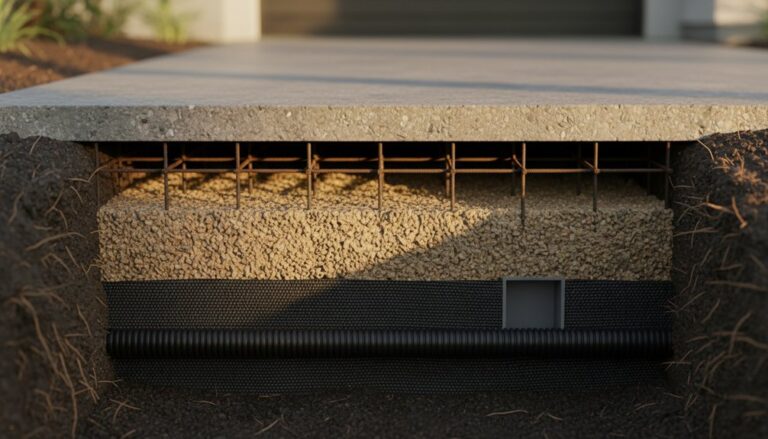
Use large-format concrete pavers to reduce joint noise and visually simplify the plane; specify a tight, consistent gap and a stable bedding layer with proper compaction. Pitch surfaces away from the foundation at 1–2% and intercept runoff with a slot drain where paths meet thresholds.
Define edges with metal edging set flush to finish grade, anchored every 12–18 inches to prevent creep. Finish paths at 42–48 inches wide for two-person passing.
Choose Low-Maintenance Plants With Clean Lines

Because a modern garden reads best when the planting supports the geometry, choose a limited palette of low-maintenance species that hold crisp form year-round and won’t spill into your paths. Prioritize architectural evergreens and clumping grasses—boxwood cubes, yew columns, feather reed grass—spaced to maintain negative space and clear sightlines.
In sun-baked corners, build succulent arrangements with echeveria, agave, and sedum in free-draining grit to prevent rot.
Use minimalist planters in fiberstone or powder-coated steel to echo your hardscape lines, and set them on pads so you can adjust alignment without disturbing paving.
Specify drip irrigation with pressure compensation and inline filters, then top-dress beds with 20–40 mm gravel mulch to suppress weeds and keep silhouettes sharp.
Add Built-In Seating, Shade, and Privacy Screens
While you’re locking in the hardscape grid, integrate built-in seating, shade, and privacy screens as fixed architectural elements that control sightlines, wind, and sun.
Set seat walls on the leeward edge of the patio to block gusts and create a warmer microclimate; cap them in smooth concrete or hardwood with a slight fall for drainage.
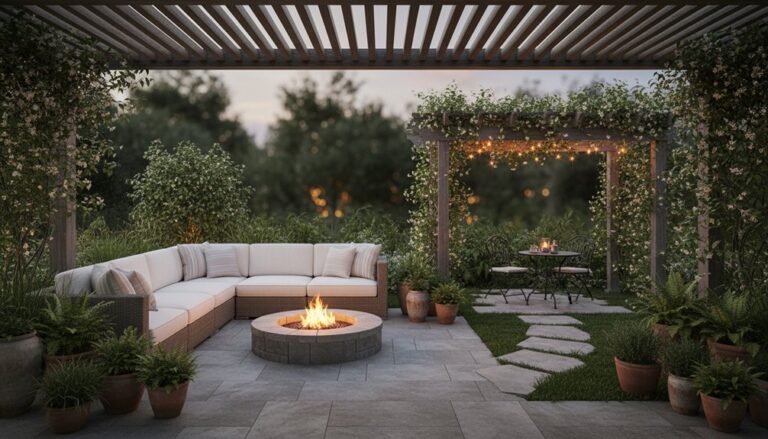
For built-in seating ideas, wrap an L-bench around a fire-safe hearth pad or align a floating bench along a retaining wall, keeping seat height near 450 mm and depth 450–500 mm.
Add a pergola or slim steel shade frame sized to the dining zone, oriented for afternoon glare.
Use privacy screen designs—slatted cedar, perforated metal, or clipped hedge panels—to mask neighbors while preserving airflow.
Layer Outdoor Lighting for a Modern Evening Feel
Fixed seating, shade frames, and privacy screens set the daytime structure; now tune the garden for night by layering outdoor lighting that reinforces the same grid and sightlines.
Start with low, glare-controlled path lights aligned to paving joints, spacing them to mark thresholds without creating runway brightness. Add wall-wash LEDs on screens to extend their planes and hide fixture bodies in reveals.
Place downlights under shade beams to pool light on the table, then aim narrow uplights at one specimen tree to anchor the far view.
Use solar powered fixtures only where they’ll get full-day exposure; keep them on secondary paths to avoid uneven output.
Finish with minimalist lanterns at seating corners for human-scale warmth and flexible re-aiming. Keep color temperature consistent at 2700–3000K.
Frequently Asked Questions
How Much Does a Modern Back Garden Retreat Typically Cost?
You’ll typically spend $15,000–$60,000 for a modern back garden retreat, depending on site grading, drainage, and hardscape square footage.
If you add a pergola, outdoor kitchen, or spa, you’re likely at $60,000–$150,000+.
Use landscaping ideas like modular pavers, composite decking, and low-maintenance planting zones matched to sun exposure and soil.
Specify lighting options: low-voltage path lights, step LEDs, and wall washes.
Do I Need Planning Permission for Pergolas, Decks, or Privacy Screens?
You don’t always need planning permission for pergolas, decks, or privacy screens, but you must check local rules, listed status, and boundary limits.
Keep decks low to avoid overlooking; elevate them and you’ll trigger consent more often.
Follow pergola design tips: fix height, setbacks, and roof coverage to stay “permitted.”
Choose compliant privacy screen materials—slatted timber, frosted glass, metal mesh—then confirm maximum heights at boundaries before you build.
How Can I Improve Drainage and Prevent Puddles After Heavy Rain?
Like a sponge overwhelmed, your garden needs a planned exit route for water. Start with a site survey: map low spots, soil type, and downspout discharge.
Regrade to a 1–2% fall away from structures, then add French drains or channel drains as core Drainage solutions.
Use permeable paving over a free-draining sub-base, plus a soakaway sized to rainfall.
Add topsoil conditioning for Puddle prevention.
What Outdoor Furniture Materials Withstand Year-Round Weather Best?
You’ll get the best year-round performance from powder-coated aluminum, marine-grade stainless steel (316), and UV-stabilized HDPE resin.
Specify durable metal finishes like thermoset powder coat or e-coat plus a topcoat to resist corrosion at fasteners and welds.
For wood, use teak or ipe with spaced slats for drainage.
Pair frames with weather-resistant cushions: solution-dyed acrylic covers, quick-dry foam cores, and breathable mesh undersides.
How Do I Keep Mosquitoes and Other Pests Away in Outdoor Seating Areas?
Keep mosquitoes and pests away by designing airflow and eliminating breeding zones. You’ll drain standing water, regrade low spots, and spec a covered, well-ventilated seating pad.
Add oscillating fans (they disrupt flight), warm 2700K LEDs to reduce attraction, and tight-closing waste lids.
Use Natural repellents like citronella, cedar, and lemongrass planters at perimeter edges.
Layer Pest control methods: Bti dunks in water features, targeted traps, and seasonal barrier sprays.
Conclusion
As you zone your back garden, you’ll notice the dining pad aligns with the kitchen sightline just as the path snaps to the gate. That coincidence makes the layout feel inevitable. Your crisp edging holds gravel and pavers in clean tolerances, while linear grasses and clipped evergreens echo the fence rhythm. You’ll sit on built-in benching under a slim pergola as privacy screens mute neighbors. At dusk, step lights, wall grazers, and downlights overlap.
About the Author