You’ll upgrade your home exterior fastest by locking paving joints, edging, and planting beds to the house’s main axes, then repeating those lines from sidewalk to door. Keep geometry crisp with steel or stone edging, tight radii, and consistent setbacks. Build layers: low groundcovers, mid-height masses, and a few vertical accents. Limit materials and plant palettes, then concentrate seasonal color in repeat blocks. Add 2700–3000K LED lighting and drip irrigation with mulch; keep going for zone layouts, pavers, and mistakes.
Key Takeaways
- Align paving joints, edging, and planting beds to the home’s axes to create strong, modern lines and clear circulation.
- Use a restrained palette of materials and plants, repeating forms and textures to keep the exterior crisp and cohesive.
- Layer planting by height—groundcovers, mid-height masses, and a few vertical accents—to frame architecture and maintain clean geometry.
- Upgrade hardscape with large-format pavers, tight joints, and slim metal edging, ensuring consistent setbacks and proper drainage pitch.
- Add modern, warm (2700–3000K) layered lighting and efficient drip irrigation with mulch to improve nighttime curb appeal and reduce maintenance.
Contemporary Landscaping Rules: Lines, Layers, Restraint

Although contemporary landscapes can look effortless, they rely on strict control. You establish strong lines first: align paving joints, edging, and planting beds to the home’s dominant axes, then repeat those vectors to guide views and circulation. You keep geometry crisp with steel or stone edging, tight radii, and consistent setbacks from walls and fences.
Next, you build layers: a low, continuous ground plane, a mid-height mass for volume, and a limited number of vertical accents to frame entries and windows. You practice restraint by limiting materials, controlling plant palettes, and reserving Garden art for a single focal point with clear sightlines.
You manage seasonal color through repeated blocks and calibrated bloom timing, not scattered specimens.
Plan Your Contemporary Front Yard Zones
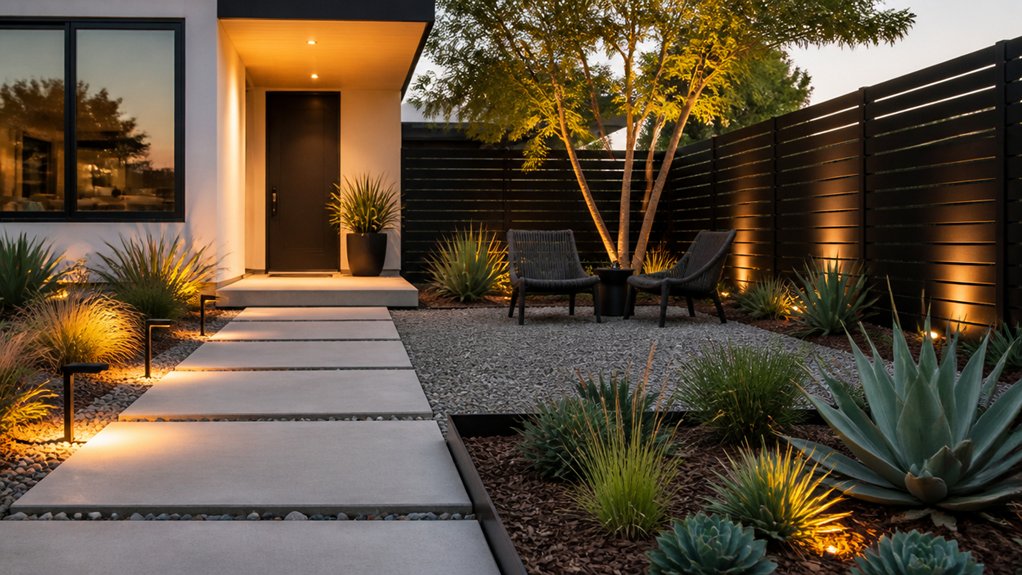
Once you’ve locked in clean lines, layered massing, and a restrained palette, organize the front yard into clear zones that support how people approach, pause, and view the house.
Start with an arrival zone: align driveway, walk, and entry landing on a simple axis, and set consistent joint patterns across paving for visual continuity.
Add a threshold zone at the door with a widened pad and lighting scaled to the façade.
Create a pause zone off the main path using low walls or planters as edges; place garden furniture to indicate intended dwell time without blocking sightlines.
Reserve a view zone oriented to primary windows and street approach; use outdoor art as a focal point, positioned on a clean plinth and lit to reduce glare.
Keep utilities screened and circulation unobstructed.
Choose Modern Plants by Shape, Texture, and Care
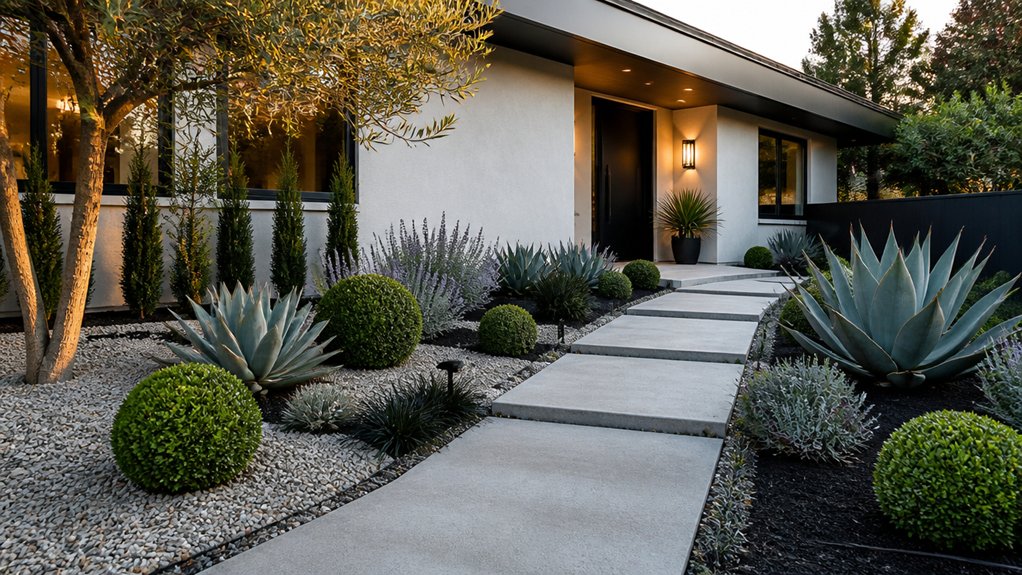
You’ll get the cleanest modern curb appeal when you prioritize structural plant forms—upright, mounded, or columnar silhouettes that reinforce your front-yard geometry.
Then you’ll balance leaf texture and color contrast against real maintenance loads, since fine grasses, fuzzy foliage, and dense groundcovers demand different pruning, cleanup, and irrigation.
If you match shape and texture to your site’s sun, wind, and soil, your planting reads crisp and stays manageable year-round.
Prioritize Structural Plant Forms
When you lead with structural plant forms, the landscape reads clean and modern year-round, even before seasonal color shows up. You’re designing with geometry: columns, spheres, fans, and low planes that echo rooflines, window modules, and hardscape joints.
Place one dominant form at key sightlines—entry, corner, or focal axis—then repeat it to establish structural symmetry without feeling rigid.
Use plant layering to control depth and scale: tall verticals at the architecture, medium mounds to connect, and ground-hugging mats to lock edges to walks and driveways. Specify plants by mature dimensions and silhouette, not bloom.
Keep spacing tight enough for massing, wide enough for air flow, and align groupings with grading and drainage patterns.
Balance Texture With Maintenance
Although fine texture can read sharp and contemporary, it also amplifies upkeep, so balance leaf scale and surface detail against your maintenance bandwidth from the start. Use coarse, durable foliage as the matrix—agave, leucadendron, lomandra, or large-leaf heuchera—then thread in finer grasses or ferny perennials only where you can edge, deadhead, and blow debris.
In windy or high-traffic zones, favor smooth leaves that shed dust and don’t fray; reserve hairy or lacey textures for protected courtyards. Limit mixed groundcovers to one or two species to reduce weeding seams.
Anchor beds with hardscape and garden art so the composition holds when plants rest, and plan seasonal color as concentrated accents you can swap, not an all-bed obligation.
Pick Modern Hardscape: Pavers, Gravel, Edging
You’ll set a modern baseline by specifying sleek paver patterns—running bond, large-format grid, or staggered modular—aligned to key sightlines and tight joint tolerances.
You can use gravel as a clean-draining field or joint infill, selecting angular stone and a stabilized base to control migration under foot traffic.
You’ll lock edges with slim metal edging, set to finished grade and staked on curve radii to keep lines crisp and maintenance predictable.
Sleek Paver Patterns
If your exterior needs a cleaner, more architectural read, sleek paver patterns give you that structure while keeping the site performance-first. You’ll define circulation with running bond or large-format grids, then tune Pattern variety to scale: tighter modules for entries, broader units for patios.
Lock lines to door centers, window axes, and driveway edges so the layout reads intentional from the curb. Use Color contrast to separate walk zones from planting bands without extra materials—light fields with dark borders sharpen geometry and improve wayfinding at night.
Specify a permeable base where possible, and keep joint widths consistent to control settlement and minimize trip edges. Add soldier courses at changeovers to resist lateral creep and protect cuts.
Gravel And Metal Edging
Gravel paired with metal edging delivers the same clean geometry you get from paver grids, but with faster drainage and finer control at curves and tight offsets. Set steel or aluminum edging on a compacted base, stake it at 24–36 inches, and keep the top flush with adjacent turf or slab to eliminate trip edges.
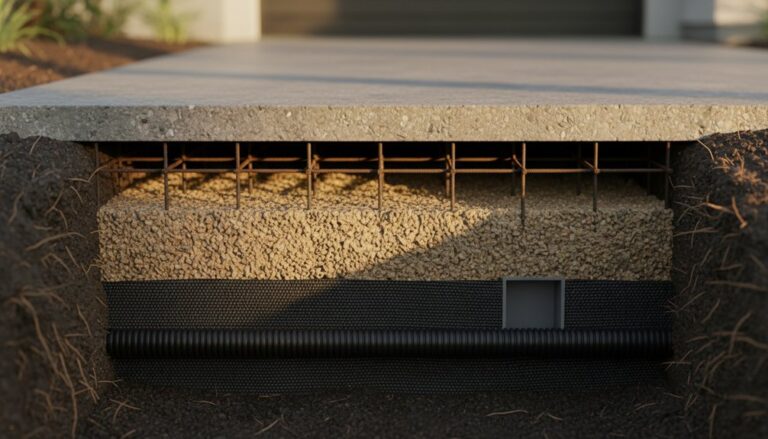
Build the gravel section like pavement: 4–6 inches of angular base, geotextile where soils pump fines, then 1–2 inches of 3/8-inch crushed stone. Specify stabilized gravel in high-traffic runs to lock surface shear.
Use edging returns to frame garden sculptures as focal nodes and to create pads for outdoor furniture. Maintain a 1–2% cross-slope to move water away from foundations and door thresholds.
Design a Clean Entry Path and Front Steps
While planting and lighting frame the façade, a clean entry path and well-proportioned front steps control how the approach reads and functions at ground level. Set your alignment from the curb to the door with a direct, readable axis, then keep offsets consistent to avoid visual wobble.
Build a stylish walkway with large-format pavers or poured concrete panels, maintaining tight joints and a crisp edge to adjacent gravel or turf. Pitch the surface 1–2% away from the house for drainage, and hold cross-slope minimal for comfort.
For the threshold, design a minimalist stairway with uniform risers and generous treads. Keep widths proportional to the door and landing. Add a landing that meets code clearances and allows turning without crowding.
Add Modern Landscape Lighting for Curb Appeal
A clean path and consistent stair geometry set the approach; modern landscape lighting keeps that clarity after dark and adds curb presence from the street.
You’ll get the best read by layering light: low, glare-controlled pathway illumination plus targeted accenting on vertical planes. Specify shielded bollards or in-grade markers at 6–8 feet on center, aimed down and across the walk to avoid hot spots.
Add step lights to define riser edges and reduce shadow gaps at landings. Use 2700–3000K LEDs, 80+ CRI, with tight beam spreads on specimen plants and wide beams on walls.
Put everything on photocell and dimmable drivers for consistent output. Mix hardwired fixtures with solar accents where trenching isn’t practical, but match color temperature and optics for cohesion.
Save Water With Drip Irrigation and Mulch
Even if you’ve dialed in plant selection, you’ll waste water if you irrigate with spray and leave soil exposed, so build the system around drip lines and a continuous mulch layer.
Lay 1/2-inch poly mainlines along planting bands, then run 1/4-inch dripline or emitter tubing to each root zone.
Match emitter flow to soil: tighter spacing in sand, wider in loam, and longer soak cycles for clay.
Zone by hydrotype so drought tolerant plants don’t share valves with thirstier beds.
Cap the system with a 2–3 inch mulch blanket to cut evaporation, moderate temperature, and prevent crusting.
Tie Rain collection into irrigation via a screened inlet and pressure-regulated filter, then schedule with a smart controller and rain sensor for seasonal tuning.
Contemporary Landscaping Mistakes to Avoid Outdoors
Efficient drip lines and a tight mulch layer handle the irrigation side, but contemporary landscapes still fail when the overall site plan prioritizes looks over performance. Don’t ignore grading, because flat pads trap runoff against foundations and stain hardscapes.
Don’t over-pave; high impervious coverage heats the microclimate and overloads drainage unless you specify permeable joints and clear discharge paths. Keep plant palettes climate-matched; trendy exotics spike maintenance and die back unevenly, breaking clean lines.
Scale your garden furniture to circulation clearances, not showroom dimensions, and anchor it on stable bases so legs don’t rut decomposed granite. Treat outdoor art as a sightline element: place it with setbacks, lighting, and wind load in mind, or it’ll read like clutter and fail prematurely.
Frequently Asked Questions
What Does Contemporary Landscaping Cost for an Average Front Yard Makeover?
You’ll typically spend $5,000–$20,000 for an average front yard contemporary landscaping makeover, depending on scope, materials, and labor rates. You control costs through plant selection (specimens vs. plugs, native palettes, spacing density) and hardscape quantities.
Add $1,500–$6,000 if you install irrigation systems with zoning, drip lines, smart controllers, and pressure regulation.
Expect design fees of 10%–15% for precise detailing.
Do I Need Permits or HOA Approval for Modern Landscaping Changes?
You might need permits and HOA approval—it depends on scope and jurisdiction. Test the theory that “plants don’t trigger red tape”: hardscape, grading, irrigation, lighting, and drainage often do.
Start by checking your city’s permitting process for setbacks, stormwater, and utility locates. Then read HOA regulations for approved materials, fence heights, and palette rules.
Submit a scaled site plan, details, and specs to avoid redesigns and delays.
How Long Will a Contemporary Landscape Renovation Typically Take to Complete?
You can typically complete a contemporary landscape renovation in 2–8 weeks, but scope drives the schedule.
You’ll finish design, staking, and utility locates in 3–10 days, then demo/grading in 2–7 days.
Hardscape and lighting run 1–3 weeks.
Plant selection and install take 2–5 days, plus establishment time.
Water features add 3–10 days for excavation, plumbing, liners, and commissioning.
Weather, inspections, and material lead times shift.
How Do I Maintain a Modern Landscape in Winter or Cold Climates?
Measure twice, cut once: you maintain a modern landscape in winter by planning protection and keeping lines crisp. You’ll apply Winter plant protection with burlap wraps, anti-desiccant sprays, and deep mulch.
You’ll cut back perennials only after hard frost. You’ll prioritize Cold climate hardscaping by sealing pavers, pitching surfaces for drainage, and avoiding de-icers that pit concrete.
You’ll store furniture, service lighting, and monitor heave regularly.
Will Contemporary Landscaping Increase My Home’s Resale Value Significantly?
Yes, it can, but you’ll see the biggest gains when you execute a cohesive plan and document it.
You boost perceived value by aligning Design principles—clean lines, balanced massing, durable hardscape—with climate-smart Plant selection that looks intentional year-round.
You’ll also reduce buyer objections by specifying low-maintenance materials, efficient irrigation, and lighting.
Expect modest-to-meaningful ROI locally; your market and curb-appeal baseline set the ceiling.
Conclusion
You’ve lined things up, layered textures, and practiced restraint like you’re designing a museum—not a yard that “just happened.” Your zones read clean, your plants show up in disciplined forms, and your hardscape doesn’t cosplay as Tuscany. The entry path lands precisely, lighting grazes edges instead of blasting glare, and drip plus mulch keeps water where it belongs. Now avoid the classics: random boulders, zigzag borders, and a dozen “statement” features competing for attention.
About the Author