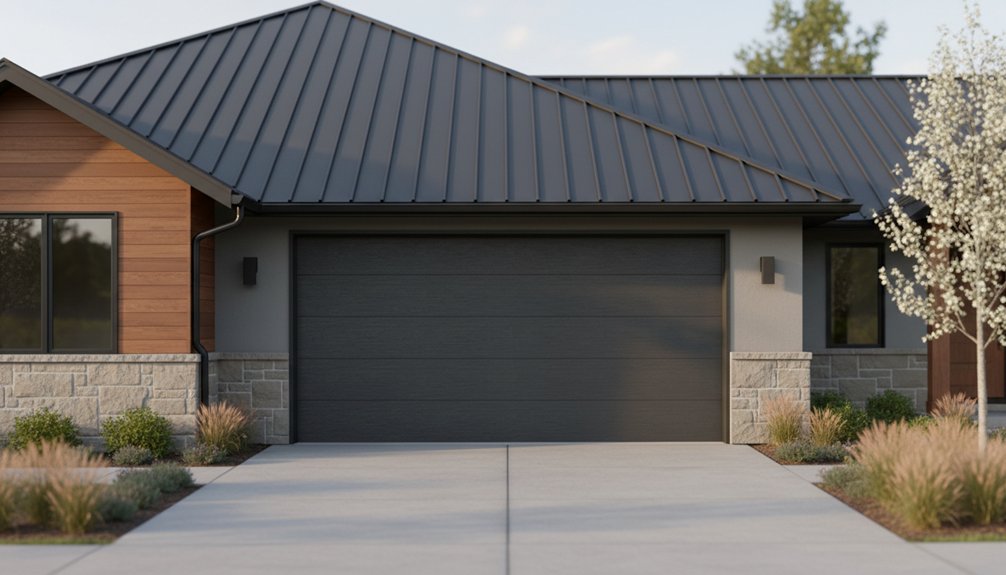
Start by confirming your roof’s undertone in outdoor daylight—warm shingles show brown/red notes, cool shingles read charcoal/blue—then choose a garage door color with low, medium, or high contrast that also repeats in your trim and fascia. Match the finish to the roof material: low-sheen for asphalt, smooth factory-like for metal, and matte/texture for tile. Test samples in sun and shade, and stay within HOA, fire, and wind-load specs. Next, you’ll see easy combinations that work.
Key Takeaways
- Identify your roof’s undertone in neutral daylight; warm reads brown/amber, cool reads charcoal/blue, and confirm against true white.
- Choose a garage door color using low, medium, or high contrast with the roof, and test samples outdoors in sun and shade.
- Match finishes to materials: matte or low-sheen works with asphalt, smooth powder-coat suits metal, and textured stains pair best with tile.
- Use trim, siding, and stone as bridging colors that repeat the roof undertone and tie the garage door into the full exterior palette.
- Avoid common mismatches: mixing warm and cool undertones, using high-gloss against matte roofing, or ignoring HOA and local design requirements.
Identify Your Roof Undertone (Warm vs Cool)

Before you try to “match” anything, you need to identify whether your roof reads warm or cool, because that undertone dictates which garage door colors will look intentional instead of slightly off.
Check the shingles in neutral daylight (no golden hour). Warm roofs show brown, red, amber, or creamy highlights; cool roofs show blue, charcoal, slate, or crisp black notes. Don’t trust online listings—pull a physical shingle sample if you can.
Confirm Color temperature by comparing the roof to a true white sheet; warm looks slightly yellowed, cool looks slightly bluish.
Also factor in Architectural styles: Craftsman and Mediterranean roofs often skew warm, while Modern and many Farmhouse palettes skew cool.
If your HOA or local design code limits colors, undertone still guides compliant choices.
Match Garage Door Color to the Roof (3 Contrast Levels)

Once you know your roof’s undertone, pick your garage door color using one of three contrast levels—low, medium, or high—so the exterior reads cohesive from the curb and still meets any HOA/design-review requirements.
Low contrast: match the door to the dominant roof tone (charcoal to charcoal, weathered wood to greige) for quiet continuity; this works best with simple garage door styles and tight roof color palettes.
Medium contrast: shift one step lighter or darker than the roof to define the opening without shouting; keep the hue family consistent and verify allowable LRV ranges if your jurisdiction/HOA references them.
High contrast: use a clearly different value (white on dark, near-black on light) only if trim, fascia, and body color repeat it. Sample in daylight.
Pair Garage Door Finishes With Roof Materials (Shingle, Metal, Tile)

Because roof materials reflect light and weather differently, you’ll get a cleaner match when you choose a garage door finish that suits the roof type—not just its color.
With asphalt shingles, pick low-sheen paint or faux-wood grain; high gloss can look patchy next to granule texture. Track roof color trends, but keep undertones consistent (warm browns, cool charcoals).
For metal roofing, choose a smooth, factory-baked finish or powder coat on the door to echo crisp lines; avoid heavy distressing.
With tile roofs, lean into matte stains or textured composite doors that won’t fight the tile’s depth.
Match garage door hardware to the roof’s visible metals (flashing, vents) and use corrosion-rated finishes for code-compliant durability in coastal zones.
Use Trim, Siding, and Stone to Bridge Roof and Door Colors
Roof-to-door harmony doesn’t rely on the roof and garage door matching each other perfectly; you’ll get a more consistent exterior by using trim, siding, and stone as the “bridge” between them.
Pick a trim color that echoes the roof’s undertone (warm brown, cool gray, or black) and repeat it on fascia, window casings, and garage framing for continuity.
Use siding as the mid-tone: lighter than the roof, darker than the trim, so your exterior color schemes read intentional.
If you’ve got stone or brick, match its mortar or dominant fleck to either the door paint or roof granules to tie materials together.
Finish with garage door hardware in the trim color; verify corrosion ratings and maintain required clearances to weather seals.
Avoid These Garage Door-and-Roof Matching Mistakes
Even if your roof and garage door look great on their own, a few common missteps can make the whole facade read “off” from the curb. Don’t match by guessing from a tiny shingle sample; view roof material choices outdoors in shade and sun, then compare against the door finish.
Avoid mixing too many undertones—cool gray roofs with warm, orange-stained doors rarely work. Don’t choose garage door styles that fight the home’s era: ultra-modern flush panels can look wrong on traditional elevations, while heavy carriage hardware can overwhelm sleek builds.
Watch sheen: a high-gloss door beside matte roofing can look patchy. Finally, don’t ignore code and specs—wind-load ratings, fire requirements, and HOA palettes can limit colors and materials.
Frequently Asked Questions
Do HOA Rules Limit Garage Door Colors That Match My Roof?
Yes, HOA rules can limit garage door colors, even if you’re trying to match your roof. You’ll need to check the CC&Rs, architectural guidelines, and any approved color palettes, then submit an ARC application if required.
Ask whether sheen, stain vs paint, and trim colors count.
Garage door material options may restrict finishes, and garage door style choices might require specific panel designs to meet community standards.
How Often Should I Repaint a Garage Door to Maintain Exterior Cohesion?
Repaint every 5–10 years, or sooner if fading or peeling breaks the look. Picture afternoon sun glazing your door; chalky streaks mean it’s time.
Your garage door material matters: steel typically lasts longer; wood needs more frequent coats.
Choose durable paint finish options—satin for balanced sheen, semi-gloss for washability.
Prep well, prime bare spots, and follow local codes/HOA rules on colors and VOC limits too.
Will Matching the Garage Door and Roof Affect Home Resale Value?
Yes, matching your garage door and roof can boost resale value because buyers read it as a well-maintained, intentional exterior. You’ll get the best payoff when garage door material choices complement roof texture and the neighborhood’s exterior color schemes.
Keep contrast subtle, avoid trendy hues, and verify HOA rules. If you replace the door, meet local wind-load/insulation ratings and fire-separation requirements where applicable, so inspectors don’t flag it.
How Do I Coordinate Garage Door Hardware With Roof Color and Style?
Choose hardware finishes that echo your roof’s undertones: pair warm shingles with oil-rubbed bronze or black, cool roofs with brushed nickel or graphite.
Like a steadfast gatekeeper, your home feels secure when every metal note harmonizes.
Match hardware styles to roof lines—sleek pulls for modern profiles, strap hinges for traditional slopes.
Keep Garage door accents minimal on dark roofs.
Verify exterior fasteners resist corrosion, meet local wind codes.
Should I Consider Energy Efficiency When Choosing Garage Door Color?
Yes—you should consider energy efficiency when choosing garage door color.
In hot climates, light colors reflect solar heat, improving cooling efficiency in the garage and reducing heat transfer to adjacent rooms for modest energy savings.
In cold climates, color matters less than insulation and air sealing.
Check local energy code requirements (IECC) for garage wall/door separation, and verify your door’s R-value, weatherstripping, and glazing specs before choosing color.
Conclusion
When you match your garage door to your roof’s undertone and finish, your whole exterior reads intentional. In fact, Remodeling’s Cost vs. Value Report shows garage door replacement recoups about 100%+ of its cost on average—proof curb appeal choices matter. Keep contrast within three steps (tone-on-tone, moderate, bold), then use trim or stone as a “transition color” so it meets HOA rules and won’t fail your neighborhood’s visual “code.”
About the Author