You’ll transform your home’s exterior fastest by zoning the front yard into arrival, passage, and service, then straightening desire lines into a primary walk axis with one clean turn. Lock geometry with crisp edging, stone borders, and pavers on a compacted base, and finish grades so water sheds into planting. Keep the palette restrained: two structural evergreens, one grasslike accent, and a groundcover, repeated for cohesion. Add warm full-cutoff lighting, bold numbers, and refined entry accents—next, you’ll see how to fine-tune every corner.
Key Takeaways
- Zone the front yard into arrival, passage, and service areas, then align a direct walkway to the entry with crisp intersections.
- Use modern hardscape materials—pavers, gravel, steel edging, and stone borders—to create clean geometry and simplify maintenance.
- Plant a restrained palette of structural evergreens, one grasslike accent, and a groundcover, repeating forms for cohesion and year-round shape.
- Finish grades to shed water into planting beds, then install drip irrigation zoned by water needs and topdress mulch annually for low upkeep.
- Add modern details—full-cutoff 2700–3000K lighting, bold house numbers, and discreet privacy screens or compact water features with hidden equipment.
Plan a Modern Front Yard Layout (Zones + Lines)

If you map your front yard into clear zones first, every modern choice that follows—hardscape, planting, lighting—will look intentional instead of random. Start by tracing desire lines from curb to door, then straighten them into a primary walk axis with one decisive turn, not meanders.
Define a public arrival zone near the sidewalk, a *passage* zone at the porch, and a service zone for bins and utilities. Use crisp edges—steel, concrete, or pavers—to hold geometry and keep maintenance tight.
Set outdoor seating where it won’t block entry: tuck a bench on a widened landing or a low terrace parallel to the facade. Add privacy screens to mask windows or parking while preserving sightlines for safety.
Keep proportions scaled to your frontage width.
Choose Modern Plants That Look Clean Year-Round

With your zones and straight walk axis set, planting becomes the finish that keeps the layout looking sharp in every season. Start by reading sun, wind, and runoff patterns, then choose plants that hold form: tight mounds, upright spires, and low mats that don’t sprawl across your lines.
Favor Native plants that stay dense without constant shearing and that match your soil texture and drainage. Build a restrained palette—two structural evergreens, one grasslike accent, and a repeating groundcover—so the facade looks intentional, not busy.
Layer drought tolerant species in the hottest exposures and reserve thirstier selections for shaded pockets near downspouts. Keep spacing exact, edges crisp, and blooms secondary to silhouette. Add mulch.
Add Hardscaping for Modern Edges and Paths
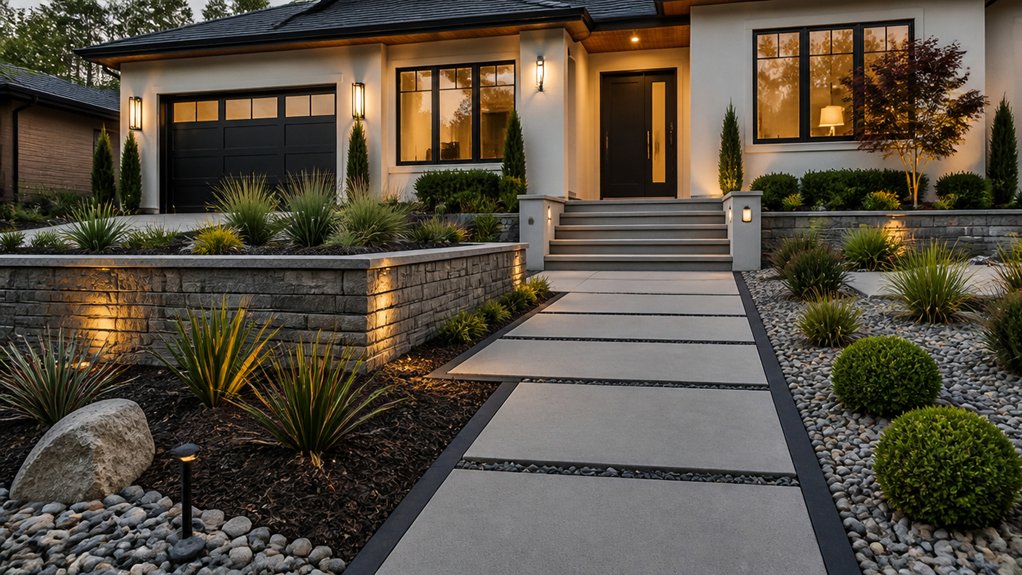
Once your plant palette reads clean and controlled, hardscaping locks the modern geometry into place and tells people exactly where to walk.
Start by mapping desire lines from curb to door, then straighten them into intentional runs with tight radii and crisp intersections.
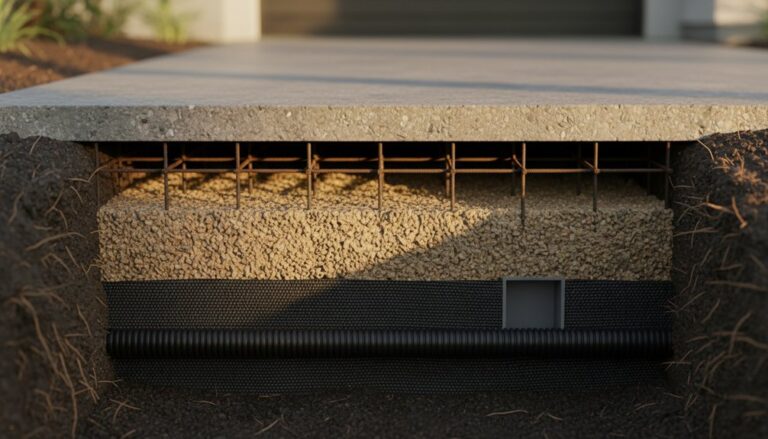
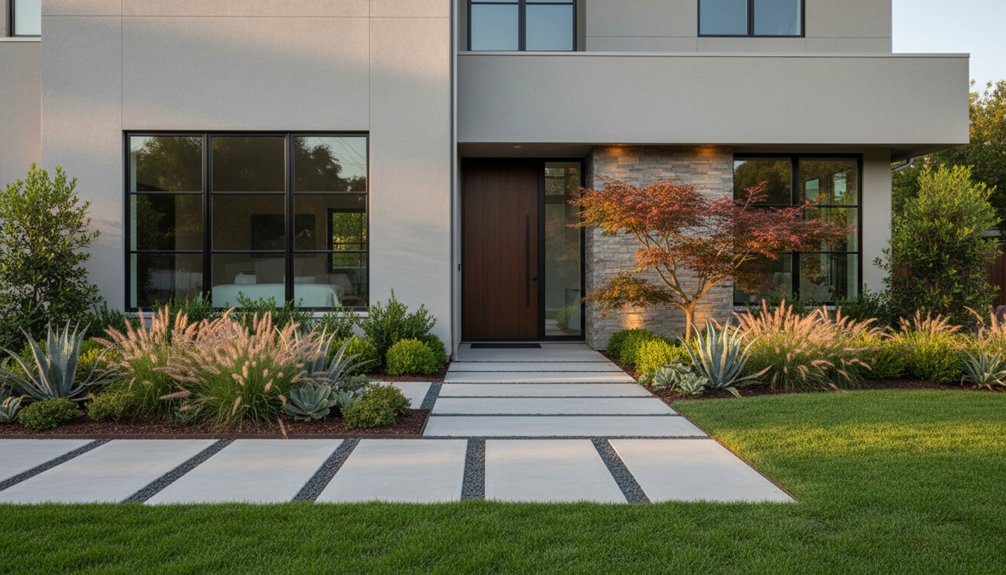
Use concrete pavers for a planar, uniform surface; set them on a compacted base with consistent joint spacing so the field reads like a single graphic element.
Control edges with stone borders to hold gravel, define beds, and create a shadow line that sharpens the composition.
Step paths should align with architecture: parallel to facade planes, centered on entries, and scaled to human stride.
Finish grades so water sheds off hard surfaces into planted zones cleanly.
Use Modern Lighting, Numbers, and Entry Details
You can sharpen your curb appeal by placing sculptural pathway lighting where it guides steps, highlights edges, and controls glare. You’ll make navigation instant with bold house numbers that read cleanly from the street and align with your façade’s lines.
Finish the approach with refined entry accents—sleek hardware, a minimal planter pair, or a crisp door surround—that ties the walk to the front door.
Sculptural Pathway Lighting
Although the walkway’s hardscape sets the route, sculptural pathway lighting defines the experience—using modern fixtures as small architectural markers that guide sightlines to the entry. You’ll place low, slim bollards or angled wedges at consistent intervals (8–10 feet) so pools of light overlap without glare. Choose 2700–3000K LEDs with full cutoff optics; they keep the façade calm and the planting legible.
Let each luminaire act like one of your garden sculptures: minimal, intentional, and scaled to the path’s width. You’ll align lighting fixtures with joints in pavers, the edge of a curb, or a planting rhythm, so the layout feels inevitable.
At the entry turn, tighten spacing and raise output slightly to signal arrival, not flood it. Use dark bronze or graphite to disappear by day.
Bold House Numbers
When the entry sequence needs a clear final cue, bold house numbers do the work with almost no footprint. Mount oversized, matte-finish digits on a smooth panel of cedar, stucco, or powder-coated steel so they read from the street line and the walk.
Align them with your door datum or a porch beam, not random siding courses, and keep spacing consistent for crisp legibility.
Use modern backlit numbers or a tight-beam wall sconce to wash the face without glare; aim light away from neighbors and drivers.
Echo nearby garden art by repeating a metal tone, then add restrained color accents through the mounting panel or a thin reveal gap.
Place numbers where foliage won’t shadow them as plantings mature.
Refined Entry Accents
After the numbers land the address, refined entry accents tighten the whole approach into a single, modern composition.
You’ll clarify the path with low, shielded LED step lights that wash the tread, not your neighbor’s windows.
Match metal finishes across sconces, mailbox, and door hardware, so the entry reads as one kit of parts.
Frame the door with a slim canopy or wood slat screen that catches shadow and echoes nearby verticals.
Keep a clean threshold: a recessed mat, a single bench, and one piece of garden art placed off-axis to pull you forward.
Let plant textures do the softening—fine grasses near concrete, broad leaves near warm siding—so the hardscape feels intentional, not harsh.
Add a discreet doorbell and camera to keep lines calm.
Keep Modern Landscaping Low-Maintenance (Irrigation + Mulch)
You’ll keep a modern landscape low-maintenance by running smart drip irrigation that targets root zones and reduces overspray on hardscapes.
Set efficient irrigation scheduling by zoning plants with similar water needs and adjusting runtimes seasonally.
Lock in moisture and clean lines with consistent mulch depth and crisp edging that separates beds from turf and paving.
Smart Drip Irrigation
Because modern landscapes look best when they stay consistent through heat waves and dry spells, smart drip irrigation delivers water exactly where plants need it—at the root zone—without wasting it on pavement, wind drift, or evaporation.
You can tuck low-profile tubing under mulch and route it along bed lines, letting hardscape edges and planting zones guide a clean, modern layout.
Use pressure-regulated emitters for mixed heights—shrubs, perennials, and foundation plantings—so each zone gets even delivery without spray overlap.
Add inline filters at the source to protect emitters from sediment, and install flush caps at line ends for quick maintenance.
When you pair drip lines with a 2–3 inch mulch layer, you reduce surface crusting and limit weeds, strengthening landscape sustainability while keeping your exterior crisp.
Efficient Irrigation Scheduling
When should you run irrigation so your modern beds stay sharp without turning upkeep into a weekly chore? Start by watering pre-dawn, when wind is low and evaporation drops, so every gallon lands in the root zone.
Schedule by soil and exposure, not the calendar: sunny curb strips need shorter, more frequent cycles than shaded foundation beds. Use your controller’s seasonal adjust to cut runtimes in spring and fall, then pause after measurable rain.
Watch for runoff on slopes; split cycles into soak-and-rest intervals so water infiltrates.
Pair Rainwater harvesting with a cistern-fed zone for accent plantings, then reserve municipal water for establishment. Once established, set lean programs for drought tolerant plants and spot-water only when leaves lose turgor.
Mulch Depth And Edging
To keep modern beds crisp with minimal babysitting, dial in mulch depth and edging so water stays where you intend and weeds don’t gain a foothold.
For mulch installation, spread 2–3 inches over soil, then pull it back an inch from stems and trunks to prevent rot and invite airflow. On slopes or windy exposures, go slightly thinner and choose heavier bark fines so it doesn’t drift into hardscape or drains.
Lock the line with clean edging techniques: cut a spade trench 4–6 inches deep for a shadow-line edge, or set steel/aluminum edging flush to grade to stop mulch creep onto walks.
Match edge elevations to irrigation zones so runoff doesn’t cross seams. Re-topdress yearly, not weekly.
Avoid the Most Common Modern Landscaping Mistakes
Even if you love a clean, modern look, a few predictable missteps can make your landscape feel sterile, high-maintenance, or out of sync with your home. Don’t default to all-gravel beds and a lone boxwood row; you’ll lose scale, seasonal interest, and neighborhood context.
Instead, repeat two to three plant forms, then layer textures that match your sun, wind, and soil.
Avoid overusing hard lines where your architecture is soft. Set crisp edging where it supports circulation, but let planting drift at corners to soften sightlines.
Skip undersized garden art that reads like clutter; choose one bold piece aligned with key views.
If you add water features, size them to the entry approach and hide equipment access in planting.
Frequently Asked Questions
What Permits Are Required for Front-Yard Hardscape or Landscape Changes?
You’ll usually need permits for new or widened driveways, retaining walls over local height limits, grading or drainage changes, work in the public right-of-way, and sometimes irrigation or lighting tied to electrical.
Check your city’s permitting process and landscaping regulations for tree removal, impermeable surface limits, and stormwater requirements.
If you add fences, steps, or patios near property lines, verify zoning setbacks and HOA rules before you start.
Call 811.
How Much Does Modern Landscaping Typically Cost per Square Foot?
Modern landscaping typically costs you about $5–$25 per square foot, depending on complexity.
About 30% of residential water use goes outdoors, so your design choices matter.
If you prioritize plant selection with region-appropriate, drought-tolerant species, you’ll lower install and maintenance costs.
Add irrigation systems like drip lines and smart controllers, and you’ll pay more upfront but reduce waste.
Hardscape, lighting, grading, and drainage push prices higher.
Will Modern Landscaping Increase My Home’s Resale Value?
Yes, modern landscaping can increase your home’s resale value, especially when you prioritize curb appeal and low-maintenance performance. You’ll attract buyers by framing clean sightlines, defining outdoor rooms, and specifying durable hardscape edges.
You can also justify a stronger price when you integrate sustainable design choices like efficient irrigation and permeable surfaces. Use drought tolerant plants to cut water costs, reduce upkeep, and signal resilience in changing climates.
How Do I Modernize Landscaping in an HOA With Strict Rules?
You modernize HOA landscaping by working inside the rulebook, then pushing design. Start with the HOA guidelines, note approved plant heights, edging, and hardscape limits, and submit a simple plan.
Use native plants in clean, repeating masses for a contemporary palette. Swap messy borders for crisp gravel or steel edging if allowed.
Add low-glare outdoor lighting along walks and entry focal points. Choose uniform mulch, prune tightly, and keep sightlines clear.
What’s the Best Time of Year to Start a Modern Landscaping Project?
Start in early fall or early spring—you’ll get roots established without summer stress, like laying tracks before the train arrives.
You’ll time Seasonal planting to your zone: cool-season grasses and perennials thrive in fall; shrubs and hardscape prep suit spring.
Factor Weather considerations: avoid frozen soil, extreme heat, and rainy spells that compact clay.
You’ll stage demo, grading, irrigation, then planting for clean lines and minimal rework.
Conclusion
You’ve got everything you need to give your home exterior a modern refresh: map clean zones, pull long sight lines, and repeat a tight plant palette that stays sharp all year. Lock it in with crisp hardscape edges, simple paths, and warm, low-glare lighting that guides the entry. Add bold house numbers and refined hardware. Dial in drip irrigation and mulch for easy upkeep. Skip clutter, mismatched materials, and random curves—it’s practically a thousand upgrades in one.
About the Author