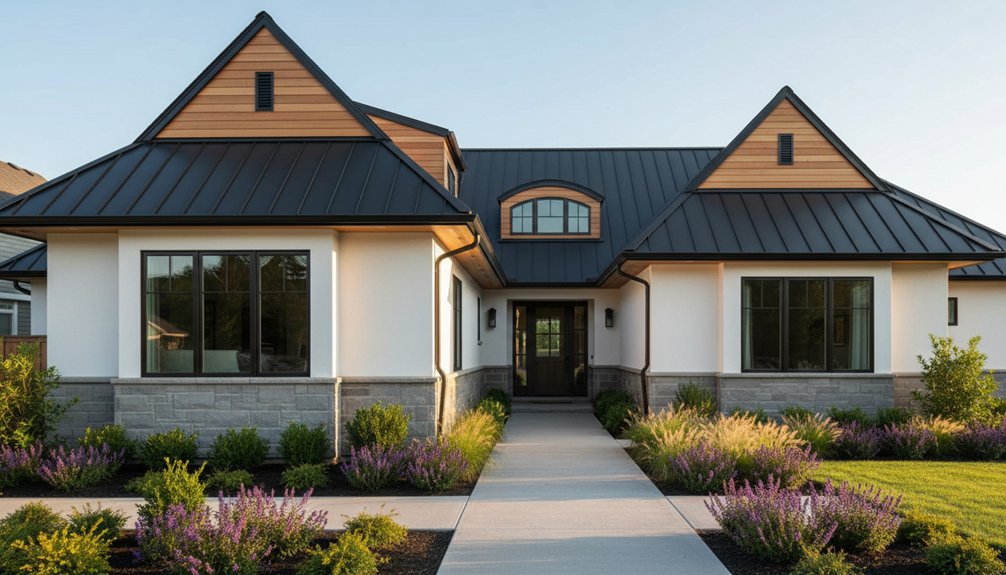
Yes—you can truly transform curb appeal with a well-designed quirky roof because it becomes the street-facing focal point and clarifies the home’s massing. You’ll get the best results by using controlled offsets, mixed pitches, clipped gables, dormers, and extended eaves that align with wall planes and window groupings, while keeping ridge heights and overhangs consistent. Expect higher costs and more maintenance from extra valleys and flashing, plus solar and drainage constraints. Keep going to see which designs, materials, and trade-offs fit your house.
Key Takeaways
- Quirky roofs can dramatically boost curb appeal by becoming the home’s strongest street-facing focal point and visual anchor.
- Offsets, mixed pitches, dormers, hips, and overhangs add depth, improve massing, and visually balance tall façades.
- They must look engineered: align ridges with walls, keep overhangs consistent, and balance visual weight to avoid a random appearance.
- More planes and valleys raise cost and maintenance, increasing flashing seams, debris traps, gutter clogs, and potential leak points.
- Complex rooflines can limit solar-friendly areas and complicate drainage, so plan runoff paths, gutters, and panel placement early.
Do Quirky Roof Designs Boost Curb Appeal?
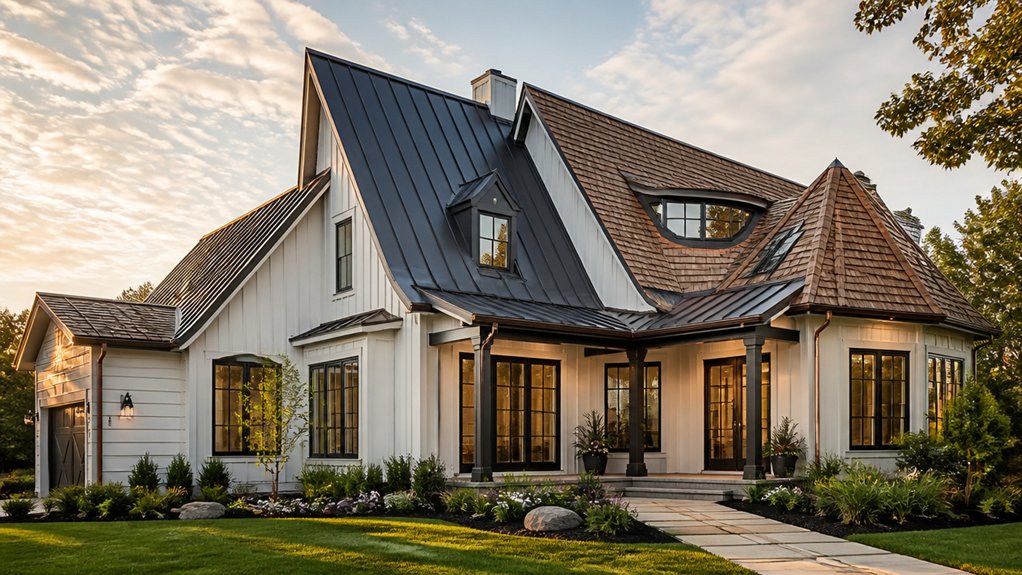
While a quirky roofline can look like a purely aesthetic choice, it often acts as the home’s strongest visual anchor from the street. You boost curb appeal when you use offsets, mixed pitches, or clipped gables to create clear massing and a readable silhouette that frames windows and entry paths.
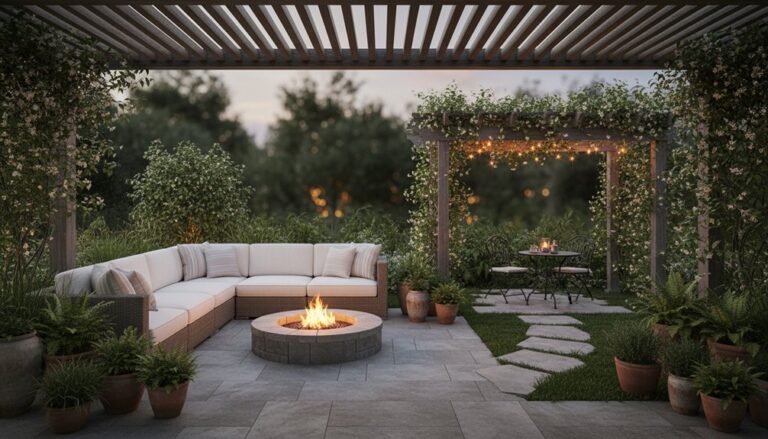
You also improve proportion: overhangs can visually lower a tall façade, while dormers can break up long planes without adding footprint. For garden integration, you can align roof breaks with trellises, pergolas, and planting beds so sightlines guide visitors to the front door.
You’ll see practical gains too: valleys, hips, and extended eaves can manage runoff, shade glazing, and improve weather resilience when detailed with proper flashing, underlayment, and ventilation.
What Makes a Quirky Roof Look “Expensive”?
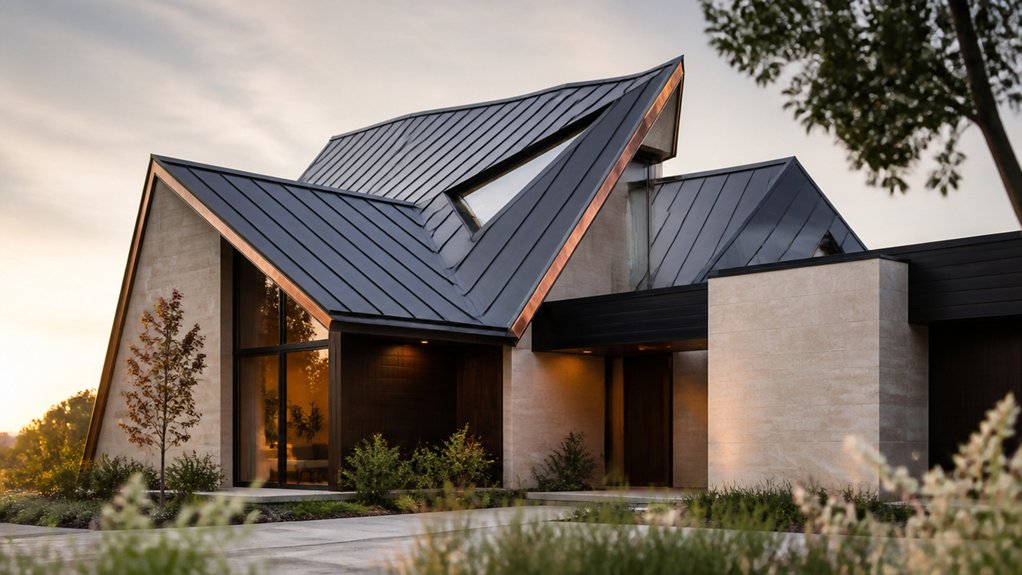
To make a quirky roof read as “expensive,” you’ll specify premium materials and finishes—standing-seam metal, slate, or high-definition architectural shingles with consistent color and sheen.
You’ll keep the geometry crisp with clean lines, tight reveals, and precise detailing at ridges, valleys, hips, flashings, and fascia so every junction looks intentional.
You’ll also control the overall massing with balanced proportions and symmetry, ensuring dormers, overhangs, and pitch changes align to a clear, repeatable rhythm.
Premium Materials And Finishes
If you want a quirky roof to read as high-end instead of gimmicky, you need premium materials and finishes that telegraph durability and precision. Specify real slate, standing-seam zinc, copper, or architectural-grade clay tile with certified freeze-thaw ratings and tight dimensional tolerances.
Choose Class A fire ratings, high wind uplift approvals, and manufacturer-backed warranties that align with your climate zone. Upgrade underlayment to self-adhered membranes and use stainless or hot-dipped fasteners to prevent staining and premature failure.
For artistic expression, invest in factory-applied coatings, patina-controlled metals, or hand-blended tile mixes that keep color stable and intentional. Let roof symbolism feel credible by selecting materials whose weight, texture, and aging characteristics match the home’s scale and façade materials.
Clean Lines, Precise Detailing
Premium materials set the baseline, but clean geometry and disciplined detailing are what make a quirky roof read as bespoke rather than busy. You’ll get that “expensive” look by controlling every edge condition: straight ridge lines, true hips, and consistent overhangs with tight fascia reveals.
Specify crisp flashing breaks at valleys and penetrations, then align pipe boots, skylights, and snow guards on a set module so nothing looks improvised. Keep ornamental features intentional—use them as accents, not clutter—by repeating one profile in dormer trims or bracket tails.
Use color contrasts with restraint: pair one dominant field color with a single complementary metal, and match gutters, rakes, and drip edges for continuity.
Balanced Proportions And Symmetry
Even when you’re mixing dormers, hips, and a bold main gable, balanced proportions keep the roof reading intentional instead of chaotic. You’ll get an “expensive” look when ridge heights step logically, pitch angles relate, and each roof mass has a clear hierarchy.
Start by aligning primary ridges with major wall planes and sizing dormers to window groupings, not leftover roof area. Maintain Symmetry balance across the front elevation: mirror key elements or offset them with equal visual weight through matching eave lengths and consistent fascia depth.
For Proportional harmony, keep overhangs uniform, cap valleys where they won’t dominate sightlines, and avoid abrupt pitch changes at intersections. When you control these ratios, the design reads engineered, not improvised, from curb to cornice.
Which Quirky Roof Designs Work by Home Style?
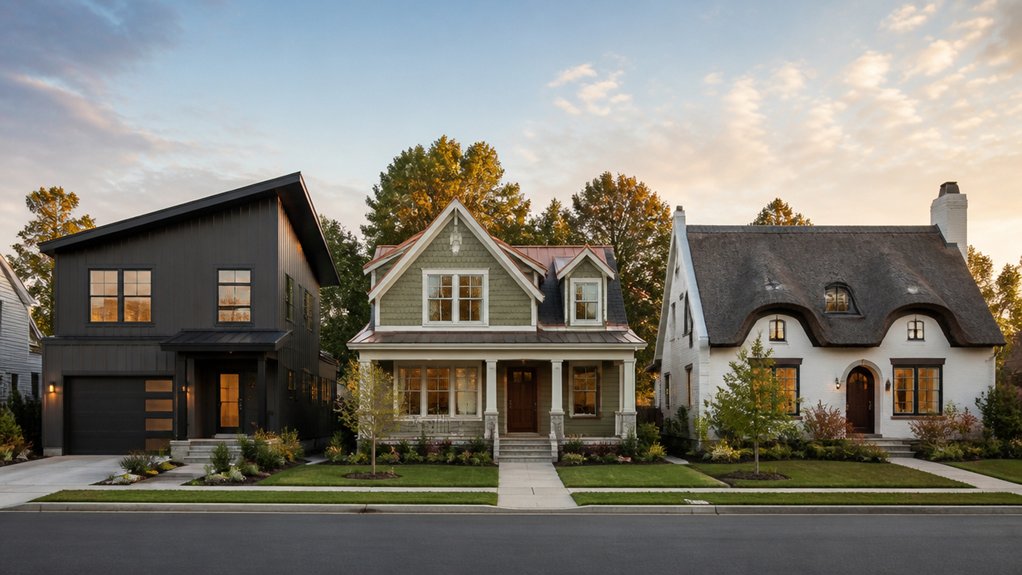
While a quirky roof can boost curb appeal fast, it only reads as “intentional” when its geometry, pitch, and detailing align with your home’s architectural vocabulary.
For a Craftsman, you’ll get the best results with a low-slung cross-gable, deep eaves, and exposed rafter tails; add a small shed dormer only if it supports garden integration through a covered porch.
On a Tudor, choose steep front-facing gables, clipped peaks, and leaded dormers; keep massing tight to preserve historical authenticity.
For a Midcentury ranch, use a butterfly or shallow mono-slope with thin fascia and clerestory glazing.
On a Victorian, go for a turret cap or patterned slate, but match finials and valley flashings precisely.
Will a Quirky Roof Fit Your Neighborhood and Codes?
Because your roofline affects sightlines, runoff, and fire behavior, you need to confirm that a quirky design won’t trigger a zoning or HOA denial before you finalize the geometry. Start by reviewing setback planes, maximum ridge height, and lot-coverage limits; unusual pitches or dormers can push you over.
Verify drainage rules: valleys, scuppers, and gutters must discharge to approved locations without impacting adjacent parcels. In wildfire zones, check required Class A assemblies, ember-resistant vents, and defensible-eave details.
Then evaluate neighborhood fit: match dominant architectural styles in massing and rhythm, and respect historical context if you’re in a conservation district. Submit elevations, material samples, and shadow studies early so reviewers can assess visibility from the street and impacts on neighboring windows and views.
How Much Do Quirky Roof Designs Cost to Build?
You’ll price a quirky roof by separating base material and labor costs (shingles/metal/tile, underlayment, flashing, crew hours) from the add-ons driven by geometry.
As your design gets more complex—multiple planes, steep pitches, curves, dormers, and custom penetrations—you’ll pay a complexity premium for extra framing, cut waste, staging, and longer install time.
You can control the total by standardizing details where possible and specifying materials and assemblies that your contractor can source and install efficiently.
Material And Labor Costs
Custom rooflines can elevate curb appeal, but they also change the cost math by driving up material waste, specialty components, and crew hours. You’ll typically buy more sheathing, underlayment, flashing, and shingles because off-cuts increase, and you may need higher-grade fasteners, membranes, or ice-and-water shield to protect vulnerable connection points.
If you want architectural harmony, you may specify premium profiles, custom gutters, or matching ridge caps, which raises unit pricing and lead times.
Labor climbs because crews must lay out more lines, cut more pieces, and install more flashing with tighter tolerances to maintain structural integrity. You’ll also pay for additional staging, fall protection moves, and cleanup.
Expect higher inspection touchpoints and more time for punch-list corrections.
Design Complexity Premium
Those added materials, specialty components, and crew hours roll up into a clear design-complexity premium once you move past a simple gable or hip roof.
When you choose creative roof shapes—dormers, cross-gables, turrets, or multiple valleys—you increase layout time, cut waste, and flashing footage. You’ll also pay for more engineering: uplift calculations, shear transfers, and custom truss packages with longer lead times.
Complex intersections demand higher-skill installers, slower sequencing, and more fall-protection setup, so labor hours climb fast. If you add skylight arrays, clerestories, or sweeping overhangs, you’ll budget for specialty membranes and ice-and-water detailing.
Even unique color schemes can raise cost when you specify custom-coated metal, multi-tone shingle blends, or staged deliveries to keep colors consistent.
What Maintenance Problems Do Quirky Roofs Cause?
While quirky rooflines can elevate curb appeal, they often introduce maintenance headaches because every extra valley, dormer, and shift creates another potential failure point. You’ll manage more seams, step flashing runs, and counterflashing junctions, and each joint demands periodic inspection and resealing.
Shingle courses get chopped into small pieces around angles, so fasteners sit closer to edges and can back out under thermal cycling. You’ll also see accelerated wear where water concentrates near valleys, causing granule loss and underlayment exposure.
Gutter clogs become more frequent when multiple roof sections dump debris into short gutter runs, leading to overflow and fascia staining. If you miss cleanouts or flashing checks, roof leaks can start as pinholes and spread into sheathing rot.
How Do Quirky Roofs Affect Drainage and Energy Use?
Maintenance issues usually show up first at joints and valleys, but the same roof geometry also dictates how efficiently water sheds and how stable your home’s thermal envelope stays.
Steeper pitches move runoff faster, yet complex intersecting planes can concentrate flow into valleys, increasing overflow risk if gutters, crickets, and downspouts aren’t sized for peak intensity.
If you plan rainwater harvesting, you’ll need clean, accessible collection zones and first-flush diverters because dead pockets and multiple materials raise debris load and contamination.
For energy use, unusual orientations create mixed solar exposure and shading.
You’ll place solar panels on planes with the best azimuth and tilt, but hips, dormers, and parapets reduce contiguous area and complicate wiring runs and mounting penetrations.
Frequently Asked Questions
Can Quirky Roof Designs Increase a Home’s Resale Value?
Yes, quirky roof designs can increase your home’s resale value, but only when you align them with neighborhood comps and buyer expectations.
You’ll boost perceived uniqueness if you maintain architectural harmony with the façade, pitch, and materials.
You should quantify cost implications: structural reinforcement, custom flashing, drainage, insulation, and future maintenance.
You’ll see better ROI when the design improves energy performance and code compliance, and you document warranties and permits.
How Long Does It Take to Design and Permit a Quirky Roof?
You’ll typically need 6–16 weeks to design and permit a quirky roof. Like plotting a ship’s course through shoals, you chart loads, spans, drainage, and wind uplift first, then navigate review gates.
Your roofing timeline often runs 2–6 weeks for concept-to-engineered drawings, plus 4–10 weeks for the permit process, depending on zoning, HOA, and structural calculations.
You’ll shorten it by pre-app meetings, complete submittals.
Do Unusual Rooflines Affect Homeowners Insurance Premiums or Coverage?
Yes, unusual rooflines can raise your homeowners insurance premiums or change coverage. Insurers price risk based on structural stability, wind uplift, and leak complexity; more valleys, dormers, or nonstandard materials can increase loss frequency and repair cost.
You’ll often need engineering letters, enhanced flashing details, and proof of code compliance. If the design maintains architectural harmony and uses rated assemblies, you can sometimes offset costs with impact-rated roofing and documented inspections.
What Roofing Materials Best Complement Quirky Designs Without Looking Dated?
Want quirky lines without a dated roof? Choose standing-seam metal for crisp geometry, longevity, and today’s trendy roofing look; specify matte finishes to reduce glare.
Use premium architectural shingles with high-definition shadow lines when you need curves and complex hips.
For bold exterior contrast, consider synthetic slate or composite shake in calibrated widths and restrained colors.
Match material profiles to roof pitch, integrate continuous ridge vents, and keep flashing details minimal.
Can a Quirky Roof Be Added During a Remodel Without Full Structural Changes?
Yes, you can add a quirky roof during a remodel without full structural changes if you keep structural considerations front and center.
You’ll typically modify the roofline with lightweight dormers, overhang extensions, or decorative gables tied into existing rafters or trusses.
You must verify load paths, uplift resistance, and tie-ins at valleys and ridges.
You’ll also check code, drainage, and flashing details to maintain architectural harmony.
Conclusion
Quirky roof designs can elevate your curb appeal when you match pitch, proportion, and materials to your home’s architecture. You’ll get that “custom-build” look by controlling lines, trim details, and high-performance finishes—without overcomplicating the structure. Still, you can’t ignore zoning, HOA rules, wind ratings, and drainage paths. If you budget for added framing, flashing, and long-term maintenance, you’ll avoid surprises—because measure twice, cut once—and protect resale value.
About the Author