Ornamental hardscaping can be the “secret” to a timeless garden, but only if you use it to set structure, not decoration. You’ll lock key views with a primary axis, define rooms with thresholds, low walls, and grade shifts, and terminate paths with a focal element. Specify dense stone, fired brick, or weathering steel that patinas well, then detail tight joints and positive drainage. Keep modules proportional to the site, and you’ll see what else makes it last.
Key Takeaways
- Ornamental hardscape isn’t the secret; timelessness comes from strong structure, clear axes, and well-defined thresholds that organize the garden.
- Classic geometry and disciplined proportions outlast novelty, using consistent modules for paths, walls, stairs, and paving alignment.
- Material longevity matters more than ornament: dense stone, fired brick, and weathering steel gain patina and character when detailed correctly.
- Craftsmanship ensures permanence—tight tolerances, proper bases, edge restraint, and drainage details prevent failure and preserve a refined look.
- Use ornament sparingly as focal points—medallions, water lips, or art—aligned to view axes to aid wayfinding without visual clutter.
Timeless Ornamental Hardscaping Elements
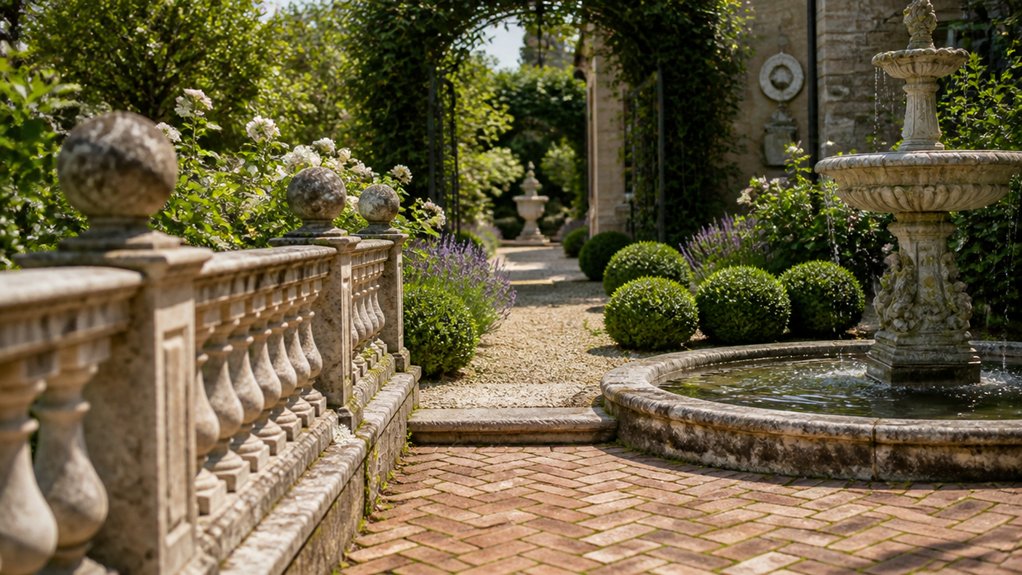
Although planting schemes change with trends, timeless ornamental hardscaping holds its visual weight because it’s anchored in proportion, material authenticity, and clear site logic.
You start with a primary axis that locks views to a gate, specimen tree, or Garden art focal, then you set thresholds with piers, low walls, or a shallow stair that matches finished grades.
You specify stone with consistent bedding planes, brick with tight coursing, and metal with a stable patina so weathering reads intentional.
You use rills, basins, and runnels where fall and drainage already want to move water.
You place pergolas and treillage to meter sun angles and cast repeatable shadow patterns.
You let seasonal plantings swap around these fixed armatures without rewriting circulation or sightlines.
What Makes Ornamental Hardscaping Feel Timeless?
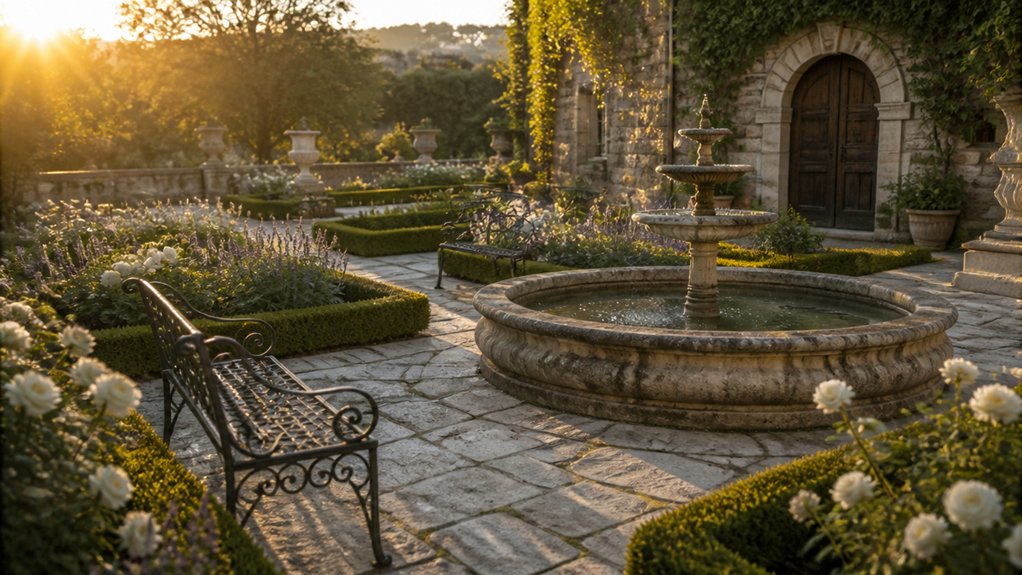
You get a timeless effect when you specify enduring materials—dense stone, fired clay, weathering steel—and insist on tight tolerances and proven joinery that can handle your site’s drainage, freeze–thaw cycles, and traffic loads.
You reinforce longevity by choosing classic forms—axial steps, simple seat walls, rectilinear borders—that read clearly against planting mass and adapt as the garden matures.
You complete it with subtle details—shadow-line reveals, eased edges, restrained inlay—so the hardscape registers as intentional craft rather than ornament for its own sake.
Enduring Materials And Craftsmanship
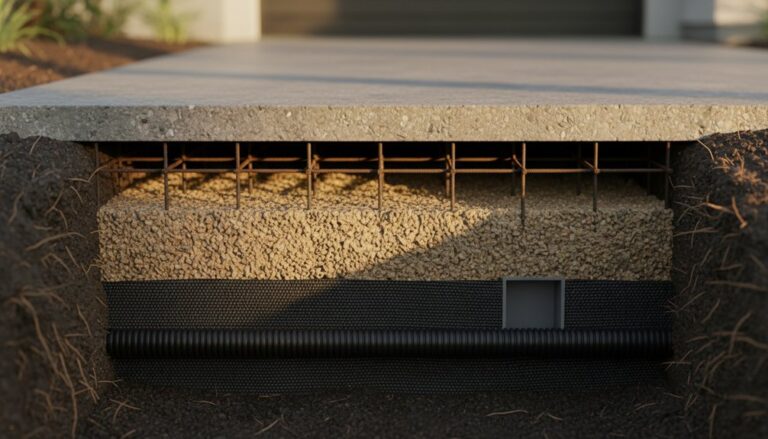
When a hardscape has to weather decades of freeze–thaw cycles, UV exposure, soil movement, and foot traffic, timelessness comes from material behavior and detailing—not ornament alone. You’ll specify dense, low-absorption stone or high-fired brick, match mortar permeability to the units, and set proper slopes to move water off joints before it infiltrates and spalls.
You’ll treat the site like a system: base depth sized for local frost line, geotextile to separate fines, and compaction verified in lifts so edges don’t creep.
You’ll honor Historical influences by choosing regionally proven materials and bond patterns, then apply sustainable practices through salvage, local sourcing, and lime-based binders that allow repair instead of demolition.
You’ll insist on tight tolerances, crisp arrises where safe, and consistent jointing to prevent differential settlement.
Classic Forms, Subtle Details
Even if the palette stays quiet, ornamental hardscaping reads timeless when the composition relies on classic geometry and disciplined shifts instead of novelty. You set a strong datum line—wall, hedge, or paving joint—and let paths, terraces, and courts lock to it with right angles or measured arcs.
You keep proportions legible: consistent tread-to-riser ratios, repeatable bay spacing, and paving modules that resolve cleanly at edges. Then you add ornamental accents sparingly: a centered medallion, a capped pier, or a water lip that aligns to an axis and catches light.
Decorative borders do the heavy lifting, too, by tightening *connections* between gravel and slab, lawn and stone, or planter and walk. You detail joints, reveals, and coping overhangs so age reads intentional.
Use Hardscaping to Create Garden Rooms
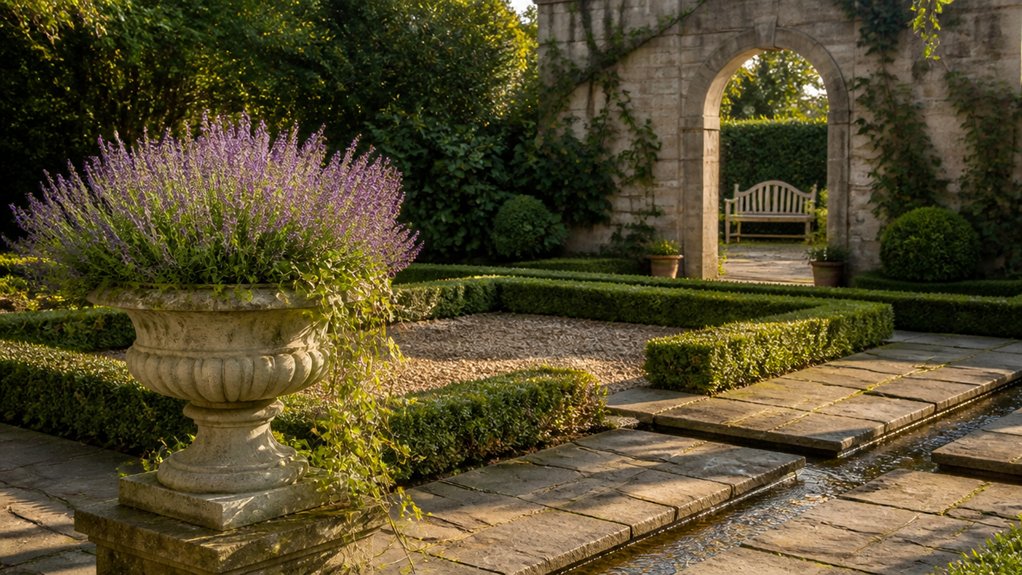
You’ll use ornamental hardscaping to define distinct outdoor zones by setting clear thresholds with paving shifts, edging lines, and grade changes matched to the site’s circulation and views.
You’ll connect each room with pathways that control pace and alignment, using consistent module sizes and joint patterns to maintain legibility from one space to the next.
You’ll add privacy with screens—perforated panels, masonry piers, or trellis walls—positioned to block sightlines while preserving light, airflow, and key focal points.
Define Distinct Outdoor Zones
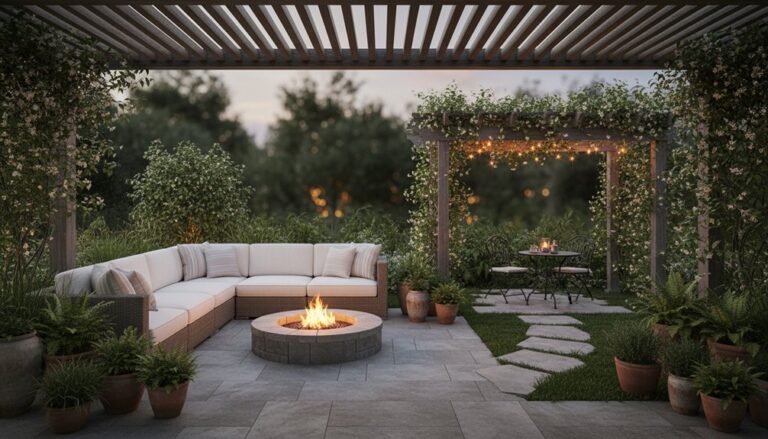
Although planting can suggest circulation, hardscaping defines outdoor zones with clear edges, grade changes, and material shifts that read as “rooms” on the site. You can set a dining court by inlaying stone within brick soldier courses, then drop it one riser to signal a lounge terrace.
Use seat walls to establish occupancy limits and align them to prevailing winds and views. A pergola or trellis frame tightens the ceiling plane, while a water rill or gravel strip creates an acoustic threshold without adding bulk.
Coordinate plant selection to reinforce microclimates at each edge condition—shade-tolerant understory inside, drought mixes on the perimeter. Integrate lighting design as boundary infrastructure: low glare step lights, downlights on vertical elements, and perimeter wash to hold the room after dark.
Connect Rooms With Pathways
When you link outdoor rooms with a path system that matches grade, drainage, and desire lines, circulation reads as intentional rather than incidental.
Set widths by function: 36 inches for single-file, 48–60 for side-by-side, and flare to 72 at thresholds.
Use permeable pavers or stabilized aggregate where runoff concentrates, and pitch 1–2% to a swale or trench drain so joints don’t silt.
Align joints, edging, and step risers to a common module so progressions feel designed.
Let the path “announce” program changes with material shifts: stone at dining, gravel at herb beds, brick at entry.
Terminate views on Garden art or a low basin among Water features, creating wayfinding without signage.
Use lighting recessed in caps to keep grades legible at night.
Add Privacy With Screens
Even if planting does most of the soft screening, hardscape screens establish the room edge, set sightlines, and control access with architectural clarity. To build garden privacy, you’ll place screens where views originate: along property lines, at patio corners, and on axis with windows.
Use low walls to block seated views and taller panels to intercept upper-story overlooks. Dial permeability with slats, perforated steel, or lattice so wind loads drop and light stays.
Tie screen designs to grade changes: step a wall with the slope, or bench it into a berm to reduce apparent height. Anchor panels to footings below frost depth, and align joints to paving grids so the enclosure reads intentional, not tacked on.
Add a gate to define threshold passages.
Materials That Patina Well (Stone, Brick, Wood)
Because hardscape surfaces sit in direct contact with sun, water, soil, and foot traffic, you should specify materials that gain character as they weather rather than degrade. Choose stone with low absorption and split faces; it keeps crisp arrises yet develops Weathered textures that read intentional.
Set clay brick on a well-drained base so salts migrate out; fired units deepen in tone and soften at edges without spalling.
For wood, use rot-resistant species or thermally modified boards, detail end-grain protection, and ventilate undersides; you’ll get a silvered patina instead of checks and punky decay.
Favor natural finishes—limewash, breathable oils, and mortar matched to exposure—so moisture can move and surfaces age evenly.
Detail joints, drip edges, and capstones to control staining patterns.
Scale Hardscaping to Fit Your Space
Materials can age beautifully, but they’ll still feel wrong if the hardscape reads oversized or fussy for the site. Start by mapping circulation: your primary path should match your body’s stride and your lot’s geometry, not a catalog ideal.
In tight courtyards, keep paving modules small and joint lines aligned to building grids to reduce visual clutter. In broad yards, enlarge unit size and extend runs so patterns don’t “buzz.”
Check space proportion by comparing hardscape width to adjacent planting depth; you’ll want enough soil volume to balance mass and soften edges. Use vertical elements sparingly: a low wall should echo nearby sill heights, while taller features must anchor a view axis.
That’s garden scale with intent.
Low-Maintenance Wins From Ornamental Hardscaping
When you specify ornamental hardscape as a working surface—not just decoration—you cut long-term labor without flattening the design. Build seatwalls, terrace bands, and gravel courts where traffic actually lands, so you’re not constantly re-edging beds or reseeding wear zones.
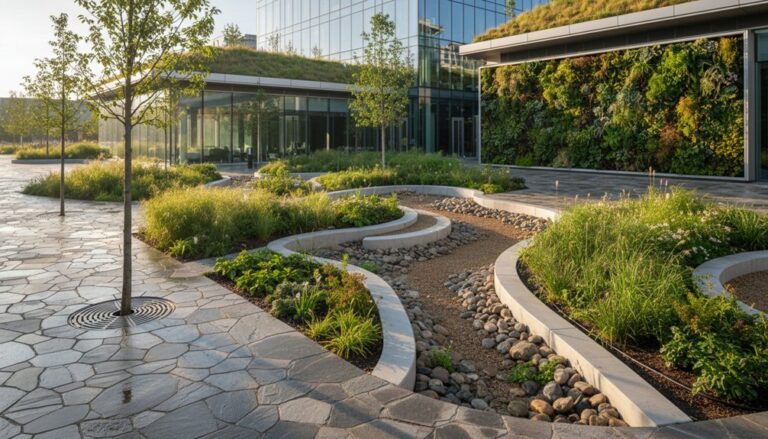
Use permeable pavers or stabilized aggregate on compacted subgrade to manage runoff and reduce mud tracking at entries.
Detail joints, risers, and coping to shed water, then let Plant selection do the softening: drought-tolerant groundcovers at paving margins, clipped evergreens at corners, and bulbs threaded through gravel for seasonal interest.
You’ll mulch less, weed less, and prune with intent because the hardscape establishes clean lines, access routes, and predictable maintenance zones.
Ornamental Hardscaping Mistakes to Avoid
Even if your palette looks cohesive on paper, ornamental hardscape fails fast if you ignore site forces and tolerances. Don’t set seat walls or plinths on uncompacted fill; specify a compacted base, edge restraint, and proper jointing to prevent creep and heave.
You’ll also regret skipping drainage: pitch paving away from thresholds, intercept runoff with a swale or slot drain, and isolate footings from saturated soils.
Avoid scale errors by tying element height, tread depth, and spacing to human use-lines and sightlines from key windows.
Don’t bury utilities; sleeve conduits for garden lighting and provide access for transformers.
With water features, oversize the basin, include auto-fill, and site pumps above flood levels, or you’ll chase leaks and winter damage.
Frequently Asked Questions
Can Ornamental Hardscaping Increase Property Value or Curb Appeal?
Yes, ornamental hardscaping can boost property value and curb appeal when you design it to fit your site. You’ll elevate garden aesthetics with durable pavers, seat walls, and lighting that define circulation, edges, and focal nodes.
You’re also delivering measurable landscape enhancement: improved drainage grades, reduced maintenance, and clearer outdoor “rooms” that buyers can read instantly.
Specify materials consistent with local architecture and climate for long-term performance and resale appeal.
Do I Need Permits or HOA Approval for Hardscaping Installations?
Yes—you often need permits and/or HOA approval, depending on scope and your site. Check local Permit requirements for retaining walls, impermeable paving, drainage tie-ins, grading, and structures over height or setback limits.
Pull utility locates and verify easements before excavation.
For HOA approval, submit a scaled site plan, material specs, and drainage details; align with color, fence, and visibility rules.
Document inspections and keep stamped drawings for resale.
How Does Ornamental Hardscaping Affect Garden Drainage and Runoff?
Like a chessboard guiding each move, ornamental hardscaping redirects drainage and runoff by reshaping grades and surface permeability. You’ll increase runoff if you install dense pavers on compacted base without joints or subdrains; you’ll reduce it with permeable units, open-graded aggregate, and edge drains.
Plan Water diversion with swales, catch basins, and outlet points away from foundations.
Control Soil erosion by armoring slopes and adding infiltration zones.
What’s the Typical Cost Range for Adding Ornamental Hardscaping?
You’ll typically spend $15–$50 per sq ft for ornamental hardscaping, with site-built stone, walls, or detailed paving running $50–$150+ per sq ft. Your range shifts with subgrade prep, drainage tie-ins, access, and local labor rates.
Higher Material durability (granite, dense pavers) raises upfront cost but cuts lifecycle replacement.
Greater Design versatility (curves, inlays, custom caps) increases layout time, cuts, and waste.
Can Ornamental Hardscaping Be Made Safe for Children and Pets?
Yes—you can make ornamental hardscaping safe for kids and pets; think of it as armor, not ornament.
You’ll prioritize playground safety by specifying slip-resistant textures (bush-hammered stone, broom-finished concrete), rounded arrises, and ADA-grade progressions at edges and steps.
You’ll choose pet friendly materials: non-toxic sealers, low-heat pavers, and grout that won’t crumble.
Add fall-zone surfacing near features, drain away puddles, and fence water elements.
Conclusion
You’re not chasing “timeless” with plants alone; you’re testing a theory: permanence comes from fixed geometry. When you anchor the site with room-defining walls, paths, and thresholds, the planting can change without breaking the concept. Choose stone, brick, or rot-resistant wood that patinas instead of failing. Scale steps, widths, and sightlines to your lot, not a catalog. Do that, and maintenance drops—because the framework carries the design.
About the Author