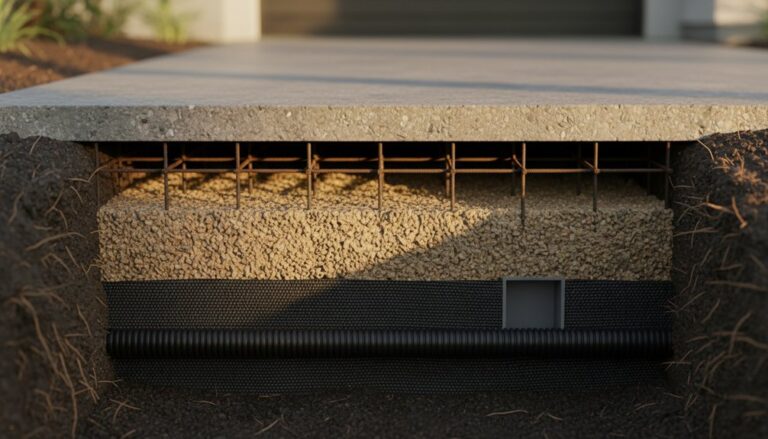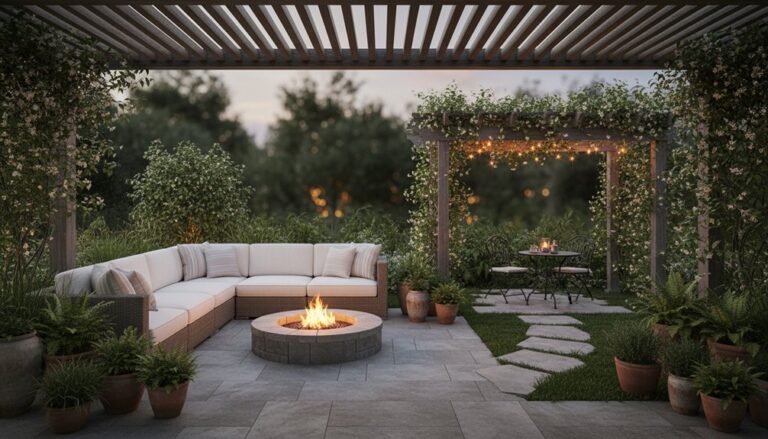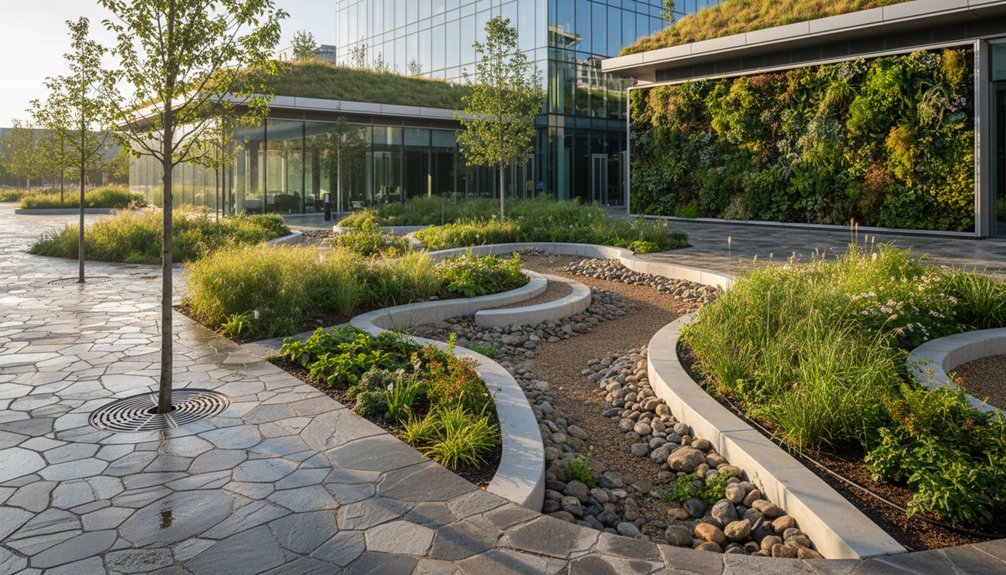
Yes—you can harmonize sustainable landscaping with urban hardscapes by designing them as one performance system. You’ll map runoff and sun to set slopes, permeable joints, and light finishes that cut ponding and heat, then route water into curb extensions, trench drains, or modular bioretention. You can use structural soils or suspended pavements so trees thrive beside utilities. You’ll size bases and select trampling-tolerant natives for durability, then verify gains with cooling, runoff, and biodiversity metrics—keep going for the tools and tradeoffs.
Key Takeaways
- Yes—treat hardscapes as part of a site-wide system that manages runoff, heat, and materials, not just circulation.
- Map sun and drainage to size slopes, permeable joints, and light finishes that reduce ponding and urban heat buildup.
- Use compact green-infrastructure tools—bioretention cells, trench drains, and blue-green roofs—to capture and evapotranspire stormwater on dense sites.
- Protect soil and plants under heavy foot traffic with reinforced subbases, modular paving, curb edges, and trampling-tolerant native groundcovers.
- Align designs with costs and regulations by early matrices for O&M, ADA/fire access, utilities, and stormwater rules, then verify performance with metrics.
How Does Sustainable Landscaping Work With Hardscapes?
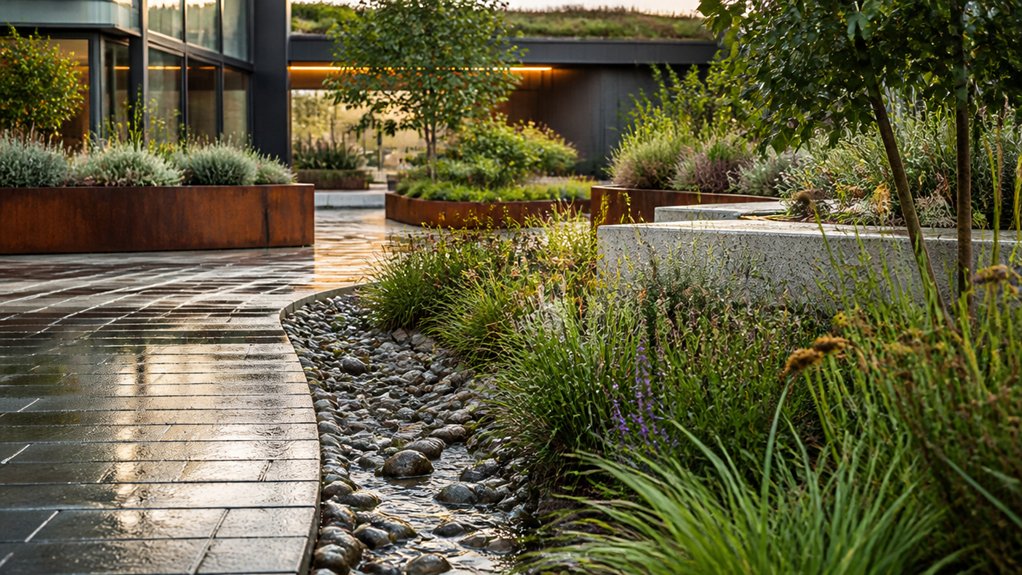
Although hardscapes seem inherently “non-green,” sustainable landscaping integrates patios, paths, and retaining elements as part of a site-wide system that manages water, heat, and material impacts. You start by mapping runoff and sun exposure, then size surfaces and slopes to move water where plants can use it, not where it erodes.
You specify permeable joints or textured, light-colored finishes to cut ponding and heat buildup, and you select durable, locally sourced materials to reduce embodied impacts. You place native plants at hardscape edges to stabilize soils, shade pavement, and intercept rainfall.
You tune irrigation to actual demand, support water conservation with mulched beds and drip lines, and maintain clear overflow routes so storms don’t overwhelm adjacent areas.
Which Green Infrastructure Tools Fit Dense Urban Sites?
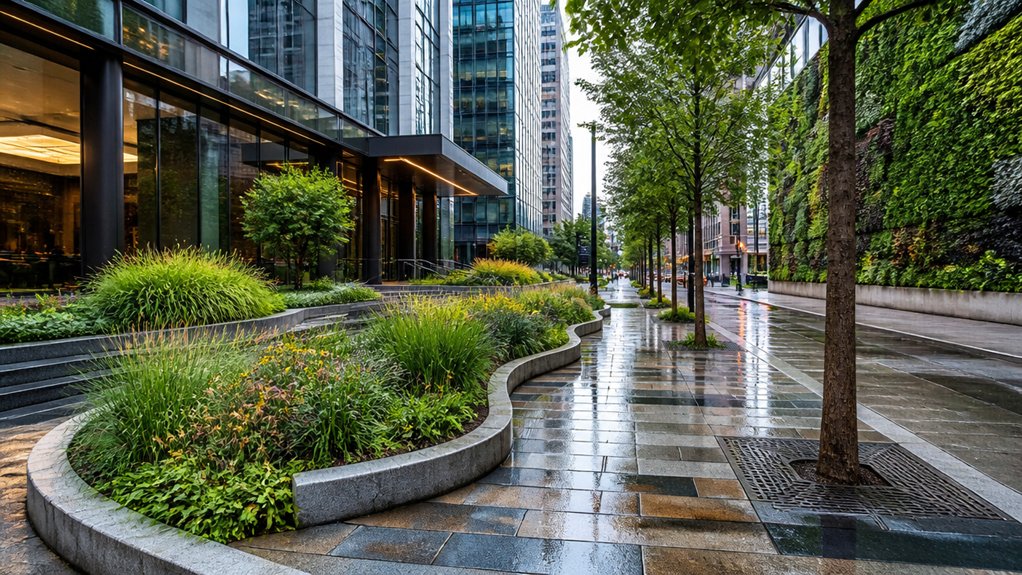
When you treat a dense urban lot as a linked water-and-heat system, you can still deploy green infrastructure by using compact, multifunctional tools that fit tight right-of-ways and shallow soils. Start with curb extensions or trench drains that route runoff into modular bioretention cells; they slow peak flows and support stormwater management without large footprints.
Specify structural soils or suspended pavements so tree roots and utilities can coexist while canopies reduce surface temperatures. Add green roofs and blue-green roof trays to store and evapotranspire rainfall, cutting combined sewer overflow risk.
Use permeable unit pavers over thin aggregate reservoirs where excavation is limited. Finish with drought-tolerant native plants in narrow planters to boost infiltration, habitat, and pollutant uptake. Integrate sensors and overflow paths for reliability.
How Do You Design for Heavy Foot Traffic and Maintenance?
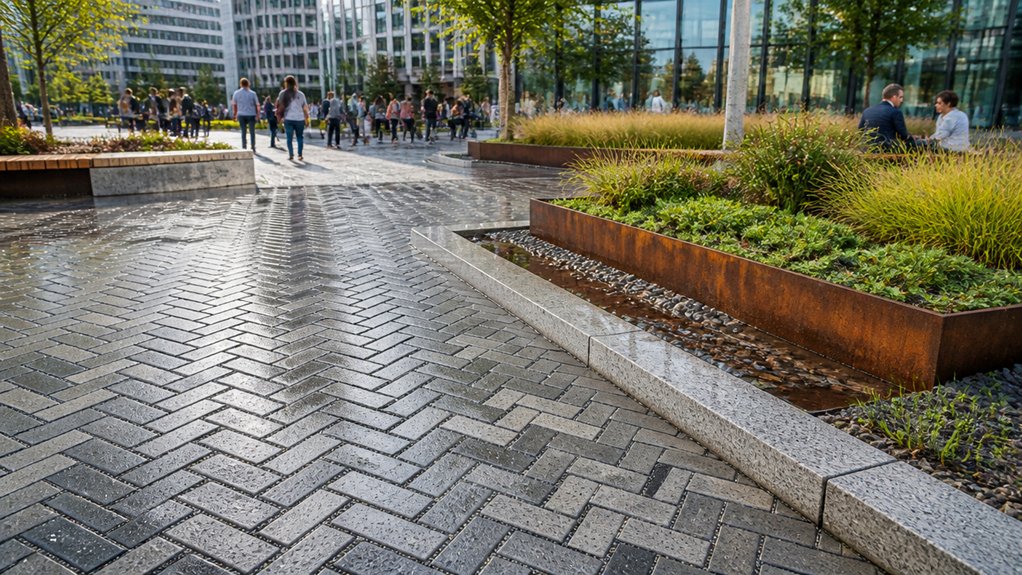
Because heavy foot traffic behaves like a repeated load case, you should design the landscape as a durable circulation-and-service system: map desire lines, quantify peak use, then assign each zone a target for surface strength, slip resistance, drainage rate, and maintenance access.
Use modular paving or reinforced turf on primary paths, and protect planting beds with curb edges, seatwalls, or permeable barriers that keep compaction out.
Specify subbase depth and geotextiles based on anticipated loads, not aesthetics.
For plant selection, choose trampling-tolerant groundcovers at edges and deep-rooted natives that stabilize soil near hardscape joints.
Pair this with irrigation management: zone valves by exposure, add moisture sensors, and keep emitters off walkways to reduce algae and slip hazards.
Plan clear service routes.
What Will It Cost: and What Will Codes Require?
To keep a sustainable landscape on budget and compliant, you’ll want to treat cost and code as design inputs, not afterthoughts: build an early matrix that ties each element (grading, paving, planting, irrigation, lighting) to its capital cost, annual O&M, and the specific requirements it must meet.
Then you’ll validate it against zoning, ADA routes, fire access, utility easements, tree protection, and stormwater rules.
Price alternates early: permeable paving vs. conventional with detention, or native plant selection vs. ornamental beds with higher labor.
For water, specify Eco friendly irrigation (pressure regulation, drip zones, smart controllers) that meets local water-use ordinances and backflow requirements.
You’ll also budget for soils testing, permits, inspections, and as-builts, so approvals don’t derail construction sequencing.
Which Metrics Prove Cooling, Runoff, and Biodiversity Gains?
Three metric families—thermal, hydrologic, and ecological—let you prove that your sustainable landscape performs rather than just looks “green.” Track cooling with surface and air temperature deltas (e.g., infrared pavement temps and 1.5–2 m air temps) plus canopy cover and shade-hours.
Track runoff with modeled and measured volume reduction, peak-flow attenuation, and infiltration rates tied to a specific design storm. Track biodiversity with repeatable indicators such as native species richness, pollinator counts, habitat connectivity, and survivorship over time.
You’ll strengthen decisions by pairing field sensors, site walks, and maintenance logs. Calibrate hydrologic models with on-site Soil permeability tests and underdrain flow meters.
Report results as avoided heat exposure, reduced CSO risk, and added Ecosystem services value. Re-measure seasonally so design tweaks show measurable performance.
Frequently Asked Questions
How Can Sustainable Hardscapes Reduce Light Pollution at Night?
You can cut light pollution reduction by designing sustainable hardscapes that control nighttime illumination at the source.
You’ll specify fully shielded, downward-facing fixtures, warm LEDs (≤3000K), and dimming with timers, motion sensors, and adaptive controls.
You’ll use low-reflectance, matte paving to prevent glare and uplight, and add integrated bollards or step lights instead of tall poles.
You’ll also set lighting zones and meet IES/IDA criteria for compliance.
Which Native Plants Thrive in Salty Roadside Splash Zones?
Picture briny mist crusting the curb; you’ll see native grasses and salt tolerant shrubs thrive there. Specify switchgrass, little bluestem, and inland sea oats for flexible stems and deep roots.
Add bayberry, inkberry, and red-twig dogwood where plows and spray hit hardest.
You’ll design in bands: sacrificial edge, buffered planting, then upland mix.
Monitor chloride, amend with compost, and irrigate deeply after storms.
Can Permeable Paving Work in Freezing Climates With De-Icing Salts?
Yes, you can use permeable paving in freezing climates with de-icing salts if you design it for ice formation control and salt tolerance.
Specify air-entrained, freeze-thaw-rated pavers or pervious concrete, and use an open-graded, well-drained base that won’t hold water.
Detail edge restraints and underdrains where groundwater is high.
Calibrate winter maintenance: prioritize brine, apply less salt, and vacuum-sweep fines to preserve infiltration capacity.
How Do You Prevent Mosquitoes in Rain Gardens and Bioswales?
You prevent mosquitoes in rain gardens and bioswales by eliminating standing water: design for full drawdown within 24–48 hours, keep inlets/outlets clear, and avoid clogged mulch.
Use Rain garden maintenance routines—seasonal sediment removal, plant thinning, and grading checks—to maintain infiltration.
Add mosquito control methods like larvicide (Bti) in unavoidable pools and encourage predators with diverse native plant structure, not fountains or constant water.
What Warranties Apply to Green Roofs and Permeable Pavement Installations?
You’re covered—if you lock in the right documents first.
For green roofs, you’ll typically get Warranty coverage split between the waterproofing membrane (often 10–30 years) and the vegetated assembly (1–5 years), plus wind-uplift and leak provisions.
For permeable pavement, expect Installation guarantees on base prep, infiltration rates, and structural performance (often 1–5 years).
You’ll validate terms with test results, maintenance logs, and inspections.
Conclusion
You weave city stone and living soil like a watchmaker marrying gears to springs: hardscape carries the load, green infrastructure returns the pulse. You route rain into bioswales, plant pockets, and permeable joints, then size them for foot traffic and easy care. You price materials, verify lifecycle costs, and meet code with clear details. Finally, you read the dial—surface temps, runoff volumes, pollinator counts—proving the system cools, soaks, and sustains.
About the Author